A TRON contract’s owner getter returns an address under that contract’s rules. It does not, by itself, identify a person, prove control of a private key, or describe the account’s signing permissions. A proxy can also expose a separate proxyOwner getter and an implementation address.
This guide is for readers who see several administrative addresses and want to keep their roles straight. On 1 November 2026, we tested three no-input view reads on the issuer-linked TUSD proxy and compared the results with TRONSCAN’s public read interface. We performed no upgrade, ownership transfer, wallet connection, signature or broadcast.
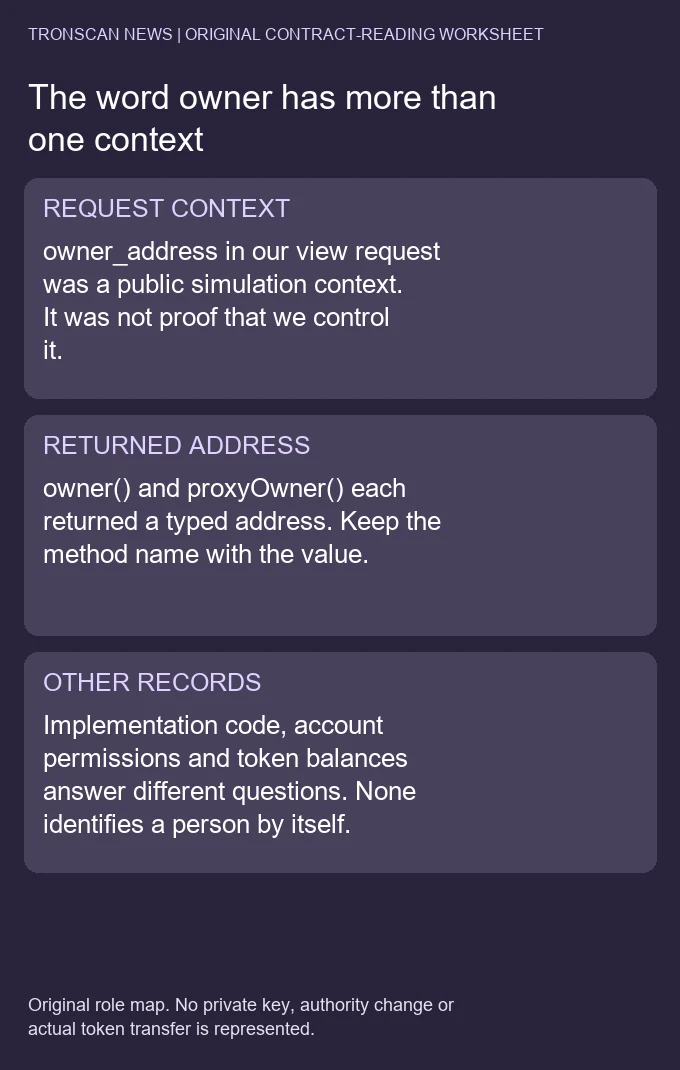
Table of Contents
Four checks for reading administrative fields
- Label the request context. A field called owner_address in a simulation request is an input. It is not automatically the getter’s output.
- Match the target and read view. Keep the complete contract address, Mainnet context and the ABI used for the method. A proxy read view and an implementation read view can expose different method sets.
- Preserve the typed result. Record owner, proxyOwner and implementation as separate fields even when two values match. Decode the returned word using its declared address type.
- Keep the conclusion narrow. A returned address is evidence about a field at a time. It is not a complete authority audit, a token-holder balance or a verified real-world identity.
The TUSD identity and proxy-reading guide explains the asset’s name, symbol and precision. This article asks a different question: which address came from which administrative or code-reference field, and what can that observation establish?
The actual target and method declarations
Our target was TUpMhErZL2fhh4sVNULAbNKLokS4GjC1F4 on TRON Mainnet. The retained contract ABI described owner, proxyOwner and implementation as no-input view functions returning an address. We did not choose a decoder merely because each output happened to look like a long hexadecimal string.
The public contract read interface displayed proxyOwner and implementation under Read Contract. Read as proxy referenced the implementation ABI and included owner. We expanded those read methods and retained the visible results. Method positions can change, so use the labels rather than fixed row numbers.
The code view identified a verified OwnedUpgradeabilityProxy source. That is a source-match observation for the displayed proxy code, not an audit of every implementation behavior. The verified-contract evidence guide explains the limits of a source match.
Three actual address returns
| Field checked | Actual returned address | How we label it |
|---|---|---|
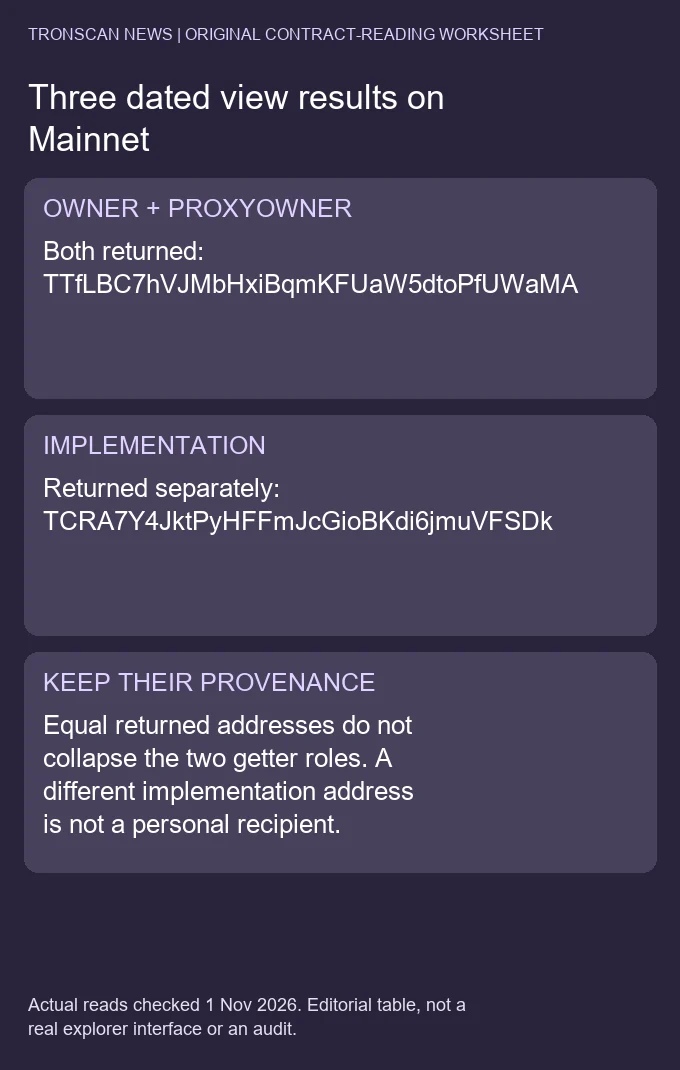
| owner() | TTfLBC7hVJMbHxiBqmKFUaW5dtoPfUWaMA | Declared getter result in the proxy-context read |
| proxyOwner() | TTfLBC7hVJMbHxiBqmKFUaW5dtoPfUWaMA | Proxy-owner getter result |
| implementation() | TCRA7Y4JktPyHFFmJcGioBKdi6jmuVFSDk | Implementation address returned by the proxy |
The first two results matched in this dated check. That does not make owner and proxyOwner the same function or establish that their authority rules are interchangeable. Keep both labels. A later state or a different contract can require a different interpretation.
The implementation result differed from the first two returned values and from the token/proxy target. Those are three distinct identifiers in our note. We did not substitute the code-reference address into a token balance query or treat any of these public addresses as a personal payment destination.
Keep the request context separate from the result
Our three anonymous requests used the /wallet/triggerconstantcontract route on the Mainnet api.trongrid.io host. In each request, both owner_address and contract_address were set to the public target address. That was an explicit choice of simulation context, not a statement that we controlled the contract or possessed a signing key.
The selected function signatures were owner(), proxyOwner() and implementation(). Each used an empty parameter string and visible: true. The constant-call reference documents this simulation route and distinguishes it from broadcasting a state-changing transaction.
Each response returned HTTP 200, top-level result.result: true and one 32-byte constant_result word. The retained transaction.ret entry was an empty object. We do not invent a visible SUCCESS string for that empty entry or use a simulation-shaped transaction object as proof of a real on-chain operation.
This distinction matters when copying an API example into a support note. The request field and the return field live in different parts of the record. Labeling both simply “owner” would lose the evidence needed to explain why their addresses differ.
Decode an address word using its ABI type
The official ABI explanation describes the standard address word as twenty address bytes left-padded to thirty-two bytes with twelve zero bytes, without the TRON 41 prefix. The prefix belongs to the TRON address representation, not to the low twenty-byte ABI value.
For our first view read, the retained word was:
000000000000000000000000c210c4150c4d087b7284031db378c81c3a2c242a
Our local decoder checked the standard length and zero padding, took the low twenty bytes, added the TRON prefix and encoded the result with a Base58Check checksum. Its output matched the explorer’s complete displayed address. The implementation word produced the separately displayed TCRA address.
This is an encoding check, not proof of who controls the resulting address. A checksum confirms a representation relationship; it does not reveal a private key, assess upgrade authority or authenticate an arbitrary source of return data.
Optional local decoder and its tested limits
The Python function below makes no network calls. It is a strict decoder for the standard single address words used in these observations. It deliberately refuses unknown length, invalid hexadecimal data and nonzero high padding rather than guessing a type.
import hashlib
import re

def decode_address_word(word):
    if type(word) is not str or not re.fullmatch(r'(?:0x)?[0-9a-fA-F]{64}', word):
        return None
    clean = word[2:] if word.startswith('0x') else word
    if clean[:24] != '0' * 24:
        return None
    payload = bytes.fromhex('41' + clean[24:])
    check = hashlib.sha256(hashlib.sha256(payload).digest()).digest()[:4]
    number = int.from_bytes(payload + check, 'big')
    alphabet = '123456789ABCDEFGHJKLMNPQRSTUVWXYZabcdefghijkmnopqrstuvwxyz'
    result = ''
    while number:
        number, remainder = divmod(number, 58)
        result = alphabet[remainder] + result
    return result
Eleven checks passed locally: the three retained real view-return words and eight synthetic inputs. The invented cases included a standard zero-address word, an optional 0x prefix, empty text, short input, invalid hexadecimal characters, nonzero high padding, a Boolean and a missing value.
The synthetic zero-address word decoded to T9yD14Nj9j7xAB4dbGeiX9h8unkKHxuWwb. It was a test fixture, not an actual pending-field observation or a statement about recoverability. We did not read a pending-owner field in this method.
The official encoding guide also describes a historical TRON compatibility form for some calls. This small helper intentionally supports the standard padded form only. A rejected nonstandard word means the helper cannot interpret it under its stated assumptions; it does not prove that every contract or historical decoder would reject that input.
Account signing permission is a different record
The official account-permission documentation describes signing permissions using keys, weights and thresholds. Those fields are account-authorization records. A named getter is a contract read, so its return value cannot replace the permission record for a question about who can authorize an account transaction.
Continue with the account-permission reading worksheet when that is the actual task. We did not inspect the returned address’s current permission configuration, identify its key holders or test a signature. A familiar permission name such as owner does not establish a human identity either.
Common mistakes and the next useful evidence
A getter is missing in the first read view. Check the target and the ABI context. Our public test needed Read as proxy for owner, while proxyOwner appeared under Read Contract. The absence of one method in a view is not proof that no related state exists.
Two getter values match. Preserve the two methods separately. Equality of addresses in one observation is narrower than equality of roles, permissions or future upgrade paths. This article does not establish that either field can never change.
A long word is decoded without a type. Obtain the relevant ABI declaration first. A 32-byte value can represent something other than an address. This decoder’s padding test is not a substitute for matching the correct method and output type.
A label is used to name a person. Keep the claim at the public-address level unless independent reliable attribution exists. We performed no real-world attribution, custody investigation or security assessment for these results.
Copyable administrative-field evidence note
Network / target contract / check time:
Read view and ABI reference:
Request owner_address, labeled as context:
Exact function signature / declared return type:
HTTP status / result fields / missing fields:
Original constant_result word:
Decoded complete address / comparison source:
Separate role fields, even if values match:
What was not checked / next evidence needed:
The success condition is a note showing which address came from which field and which inference remains unsupported. This test created no ownership-transfer receipt. A returned address is a reading result, not authorization to change anything or an instruction to send funds.
Frequently asked questions
Does a contract owner getter identify a person?
No. It returns a contract-defined address value. We did not establish a real-world identity or private-key control.
Is request owner_address the same as the getter result?
Not necessarily. Our request used the target as simulation context, while the getter returned a different address.
Do matching owner and proxyOwner results make the roles identical?
No. Keep both methods and values in the record. Our equality observation does not audit their authority rules.
Is the implementation address a personal recipient?
It was a code-reference result in this check. This guide gives no personal receiving instruction and does not substitute it for the token target.
Did the decoder or view reads change ownership?
No. The decoder ran locally and the public methods were read-only. No ownership-transfer control, signature or broadcast was used.
Independent Tronscan News review with AI-assisted drafting and primary-source checks on 1 November 2026. Three anonymous view reads, three matching public-interface observations, eleven local decoder checks and two original diagrams support this worksheet. No private-key control, real-world identity, security audit, token-holder balance or authority change is claimed. Browse the Tronscan News homepage; corrections can be raised through About & Standards.
Leave a Reply