TUSD is the symbol for TrueUSD, a stablecoin project distinct from Tether’s USDT. On TRON, identify it through the issuer-linked contract address before reading a balance or transfer amount. A dollar-like name or a familiar logo is not enough to establish which asset a record describes.
On 1 November 2026, we followed the TrueUSD website’s TRON reference and inspected its public contract on TRONSCAN. The read-only proxy interface returned name = TrueUSD, symbol = TUSD and decimals = 18. This article explains how to reproduce those identity checks and interpret their limits. We did not connect a wallet, sign, transfer, mint or redeem anything.
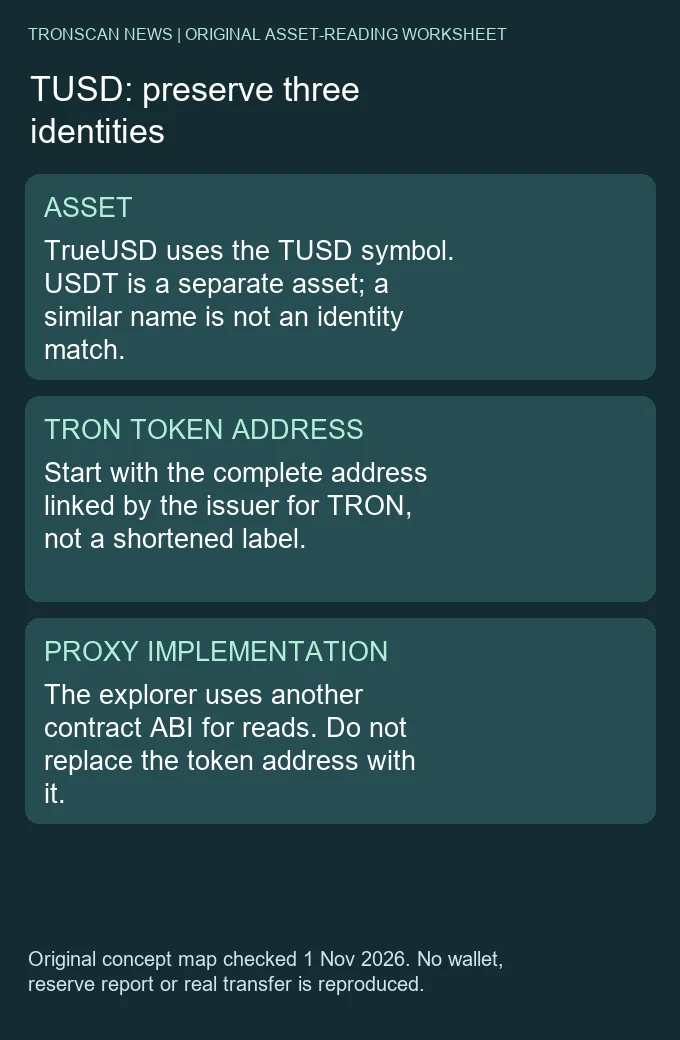
Table of Contents
What is TUSD on TRON?
The TrueUSD issuer website lists TRON among its native deployments and links the address below. It separately lists deployments or bridged versions on other networks. Use the network-specific source rather than carrying an Ethereum address into a TRON search.
Issuer-linked TRON token contract:TUpMhErZL2fhh4sVNULAbNKLokS4GjC1F4
That is a token contract, not a personal receiving address or a redemption instruction. This article provides a record-reading route. It does not establish that a particular exchange accepts TUSD deposits, that an account can redeem it, or that its market value equals one dollar at a given moment.
The existing USDT explorer and network-selection guide remains the route for a USDT question. Here the separate task is identifying TrueUSD and its eighteen-decimal TRON units. Renaming a TUSD amount as USDT would change the asset, even if both records came from the same network.
Our checked fields and what they answer
| Observation on 1 November | Observed value | Scope |
|---|---|---|
| Issuer’s TRON link | TUpMhErZL2fhh4sVNULAbNKLokS4GjC1F4 | Network-specific deployment reference |
| Read as proxy: name | TrueUSD | Public string returned by the read interface |
| Read as proxy: symbol | TUSD | Public ticker string |
| Read as proxy: decimals | 18, type uint8 | Scale for raw token units |
| Issuer transparency supply display | — | No numeric value available in our page observation |
The values are a dated observation, not a standing guarantee of future contract state. We retained the issuer URL, explorer network, complete token address and read results together. A name or symbol returned by an arbitrary contract would not establish an issuer relationship by itself.
Do not confuse the returned value with its type
The tested decimals result appeared beside the type uint8. In that pair, 18 is the returned value; uint8 describes the unsigned integer type. The “8” in the type is not an instruction to divide the TUSD amount by ten to the eighth power. Copying only the type would discard the field result that the conversion actually needs.
The same distinction applies to the other two observations. TrueUSD and TUSD were returned text values, while string was the type label. A note that says “symbol = string” would record the category of data instead of the symbol itself. Our worksheet preserves both the result and its type to make that error visible.
When reading a screenshot, look for the method name, result and type together. If an image cuts off the method label, the remaining number cannot safely be assigned to a token balance, precision, fee or supply. Ask for the complete public record context rather than filling in the missing label from memory. This is a field-identification check; it does not authenticate the screenshot or establish a particular holding.
Why Read Contract and Read as proxy differ
The public TUSD contract page displayed a verified proxy source named OwnedUpgradeabilityProxy. Its code view and ABI concern the proxy layer. The explorer also offered Read as proxy, which supplies the implementation ABI for the public reading interface.
That distinction explains why a reader looking only at the ordinary Read Contract tab may see proxy-management fields rather than the expected token metadata. It does not mean that the token lacks a name or decimals field. It also does not justify moving to a write tab or approving a wallet prompt to reveal public information.
| Address role | Reference observed | How to use it here |
|---|---|---|
| Issuer-linked token/proxy | TUpMhErZL2fhh4sVNULAbNKLokS4GjC1F4 | Keep this as the asset identity in the reading note |
| Implementation ABI reference | TCRA7Y4JktPyHFFmJcGioBKdi6jmuVFSDk | Record it as a separate observed implementation reference |
Do not replace the token address with the implementation address in a balance query or payment instruction. The two addresses have different roles. This guide does not audit the implementation, identify every authority, or certify upgrade safety. A source match is not a safety guarantee. Our TUSD page observation also showed OK; the reputation-label worksheet explains why that explorer label does not certify reserves or redemption.
Reproduce the three read-only TUSD checks
- Start at the issuer reference. Open its network list and follow TRON. Record the full linked address and check date. A shortened label on the transparency page is a display convenience; use the complete destination address for comparison.
- Confirm Mainnet and the address. Check the explorer’s network label and the full contract identifier. Stop if either differs from the intended reference. A similarly named result on another network is a separate record.
- Open Contract, then Read as proxy. Our checked interface displayed an implementation-ABI reference above the method list. Keep that reference separately. We used the visible label to switch views; no wallet was connected.
- Expand name, symbol and decimals. These no-input methods returned TrueUSD, TUSD and 18 in the tested session. Record each returned value and type. Do not treat the absence of a result during loading as an empty string or a zero.
- Write down the boundary. These are metadata observations. They do not measure backing assets, current redemption availability, market price or acceptance by a receiving service.
The method numbers and placement can change. Find the method labels rather than relying permanently on the positions shown in our session. If the expected read view or return is unavailable, preserve that fact and the check time; do not claim a successful call from a generic reference document.
Convert raw TUSD units with the observed scale
For the checked eighteen-decimal deployment, a raw integer is divided by 10^18 to express a TUSD quantity. The exponent is a token-unit scale, not a fee, interest rate or price. Copy the integer as a string before processing it; long values can lose precision when handled as ordinary floating-point numbers.
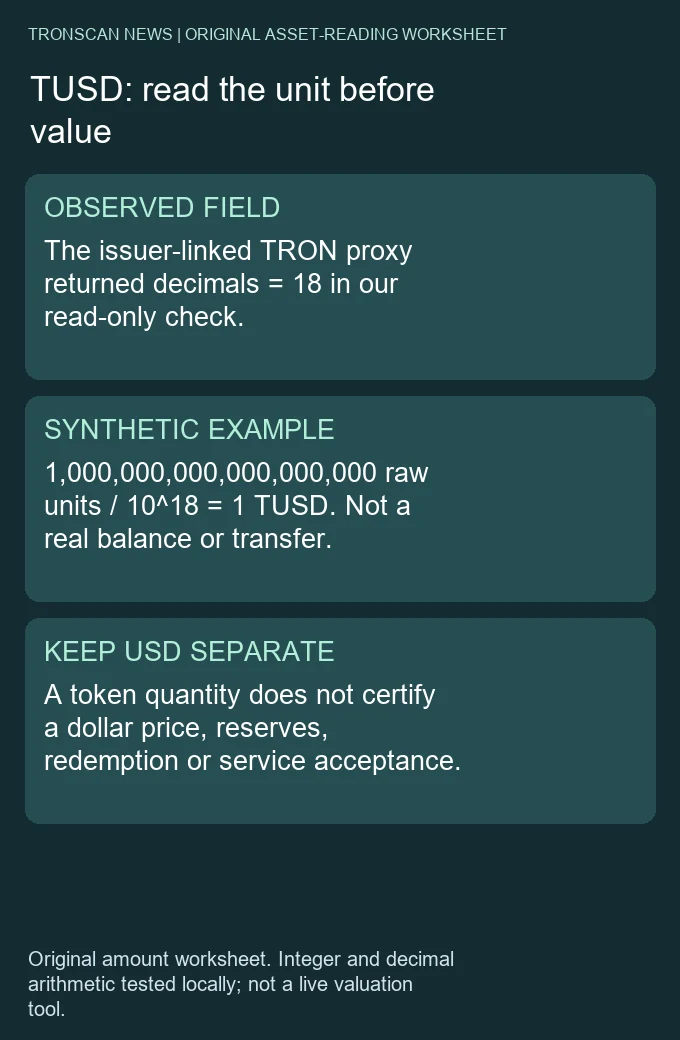
Synthetic examples: the following values were invented for this worksheet and verified locally using exact decimal arithmetic. They are not wallet balances, transfer receipts or supply figures. Every row assumes the same observed eighteen-decimal token definition.
| Invented raw integer | Divisor | TUSD quantity |
|---|---|---|
| 1 | 10^18 | 0.000000000000000001 |
| 1000000000000000000 | 10^18 | 1 |
| 1234500000000000000 | 10^18 | 1.2345 |
| 1000000 | 10^18 | 0.000000000001 |
The last row illustrates a unit error: a familiar-looking integer does not establish a familiar token amount. Do not borrow a precision rule from another asset simply because its ticker also contains “USD.” Conversely, a page that already displays a human-readable TUSD quantity should not be divided by the scale again.
Record whether the starting field is raw units or an already formatted amount. If you cannot establish that distinction, keep both the field label and raw text and stop before converting. A correct arithmetic result with the wrong starting unit still gives a misleading amount.
Separate the token quantity from USD value
A TUSD quantity is a number of tokens. A USD value additionally depends on a valuation method, price source and observation time. Neither our metadata reads nor the invented arithmetic cases supply that price evidence. We have not calculated a current dollar value for a real holding.
This matters for a historical transfer as well as a present balance. A current price display cannot establish the dollar value at the time of an earlier movement. If a record contains an estimate, retain its date and label instead of presenting it as a guaranteed redemption amount.
Our raw-unit and formatted-amount explanation develops the general distinction using USDT. Its token-specific precision must not be copied into the TrueUSD examples above. The method transfers; the asset identity and scale must be checked again.
What the transparency page did not establish
The issuer’s transparency page links the TRON deployment and an attestation presentation. During our observation, the circulation fields showed --. We did not treat that placeholder as zero circulating tokens, a zero account balance, or proof that reserve assets were absent.
We did not complete an attestation-report audit. A token address, symbol and decimals value cannot establish reserve sufficiency, the legal terms of redemption or a customer’s ability to redeem. Those questions require the relevant dated report, scope and terms. The issuer page’s general transparency claims are not a substitute for checking a particular report.
Similarly, the contract’s source-verification label does not certify the issuer’s finances. Keep technical identity evidence and financial backing evidence in different rows. Combining them into a single “verified” badge would conceal what has actually been checked.
Common failure branches
- The symbol says TUSD but the address differs. A ticker match is insufficient. Return to the issuer’s network-specific reference and compare the complete destination. Do not infer a relationship from a logo or a search ranking.
- The address is right but the method list looks wrong. Check which read interface is selected and whether an implementation ABI is supplied. Our metadata test used Read as proxy. Do not choose a write operation as a troubleshooting shortcut.
- A call is blank or still loading. Mark the field unavailable at that time. It is not a confirmed zero. If the interface later returns a value, retain the later observation separately.
- The amount looks unexpectedly large. Check the original unit and the eighteen-decimal scale before interpreting it. A formatting mistake is different from evidence of a large transfer.
- A deposit service names another asset. Stop at the mismatch. A TRON address can appear in multiple asset contexts, but that does not establish a service’s acceptance of TrueUSD. Use its exact asset-and-network instructions.
These branches are reading decisions, not recovery instructions or a recommendation to move funds. This site has no tested account-specific acceptance checker. We cannot reverse a transfer, change an issuer record or confirm private exchange credit from the public metadata.
Copyable TUSD evidence note
Success means the note names the exact asset, network and source, preserves the raw unit, and leaves unsupported conclusions unknown. Use this structure before summarizing another person’s screenshot or an explorer record.
Checked date and time:
Issuer URL / network:
Full token address:
Read interface / implementation ABI reference:
Observed name / symbol / decimals and types:
Amount field label / raw text / raw or formatted:
Conversion used, if applicable:
Price source and time, if any:
Reserve or service-acceptance evidence: checked / unknown
Unanswered question and next evidence needed:
Keep a genuine transaction hash only if the task includes a transfer. The metadata check above did not generate one. A local arithmetic test likewise has no chain receipt. Do not invent a hash to make the evidence note look complete.
If you later repeat the check, retain the new observation time rather than overwriting the earlier result. A changed implementation reference, source label or returned field deserves review; it should not be dismissed merely because the ticker remained the same. We have not claimed that such a change occurred during this test.
Frequently asked questions
Is TUSD the same as USDT?
No. TrueUSD and Tether’s USDT are separate assets. Match the issuer-linked contract and network before reading the amount.
How many decimals did the TRON TUSD read return?
Our 1 November 2026 Read as proxy check returned 18. Keep that deployment and check date with the result; do not apply the number to every token sharing a similar name.
Why are token metadata fields missing from Read Contract?
The ordinary view can expose the proxy’s own ABI. Our tested metadata route was Read as proxy, using the implementation ABI reference while keeping the issuer-linked token address.
Does the — supply display mean there are zero tokens?
No. It was a missing numeric display in our observation. We did not verify a supply total from it.
Does identifying TUSD prove redemption or deposit support?
No. Technical identity does not establish reserve adequacy, personal redemption eligibility or a receiving service’s supported asset list. Those require separate evidence.
Prepared by the independent Tronscan News editorial team with AI-assisted drafting and source review on 1 November 2026. Two original diagrams, the address-role matrix and synthetic arithmetic worksheet were created for this article. Test scope: public issuer pages, three no-input explorer reads and local exact arithmetic. No wallet connection, signature, transfer, redemption, price feed or reserve audit was performed. Browse the Tronscan News homepage; corrections can be raised through About & Standards in the navigation.
Leave a Reply