TRX options were included in Blockchain.com’s October 2026 options launch for eligible Trading Account users. They are price-linked financial positions, not a delivery of native TRX to a TRON address. A blockchain explorer therefore answers a different question from the provider’s position and settlement records.
This is a 1 November review of an October announcement. The provider blog displays 17 October; the TRON DAO page displays 28 October and carries a 21 October dateline. Those dates are retained separately below. We have not established one exact commercial launch time or tested availability for an individual account.
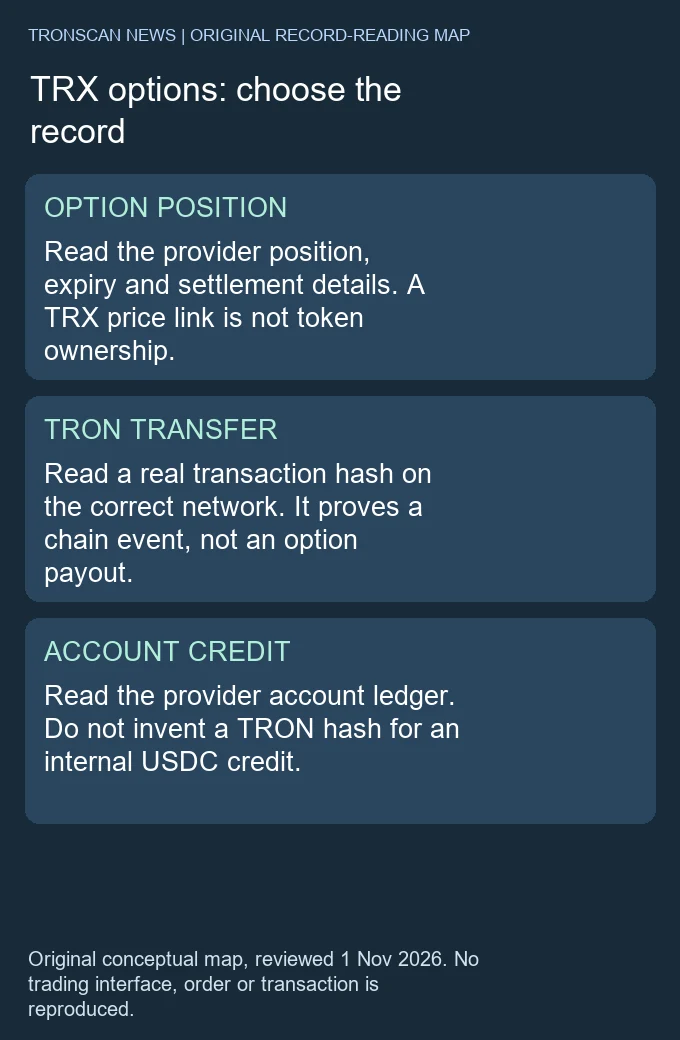
Table of Contents
What the October TRX options announcement establishes
The provider’s launch article names TRX among the underlying assets for call and put options. It places the product in the Trading Account, describes upfront funding in USDC, and limits access to eligible users in supported jurisdictions. Its initial expiry range extends up to one week and positions must run through settlement.
The TRON DAO announcement independently identifies the TRX product and repeats the eligibility boundary. This confirms what the organizations announced. It does not establish that a reader in a particular country can access a quote today, or that the feature creates a TRON wallet balance.
For readers arriving through the Tronscan News home page, the useful distinction is the object being inspected: a provider contract, a native coin balance, or a public chain transaction. The ticker TRX can appear in each context without making the records equivalent.
TRX options source chronology: keep three dates separate
| Evidence checked | Date shown | What we retain |
|---|---|---|
| Blockchain.com launch blog | 17 October 2026 | Visible publication label on the provider’s article |
| TRON DAO page header | 28 October 2026 | Website page date, separate from the body dateline |
| TRON DAO press-release body | 21 October 2026 | Dateline printed inside the release |
| This editorial check | 1 November 2026 | Our source review, not the product’s launch date |
This chronology table is an editorial comparison of public labels, not a reconstruction from an order log. No timezone is supplied for those date-only labels. A later page header can coexist with an earlier dateline; neither permits us to rewrite the event as a new launch on our publication day.
TRX options and native TRX need different evidence
The provider’s options explanation supplies the key distinction for TRX options: price exposure differs from owning the underlying cryptocurrency. It also separates a selected target from the actual strike and explains that purchase cost and fees matter to the final result. A price moving in the expected direction is insufficient evidence of a profitable settled position.
| Question | Record to inspect | What that record cannot settle |
|---|---|---|
| Does this account hold an option? | Provider position details with underlying, direction, strike and expiry | A public address balance cannot certify the account’s private positions |
| Did native TRX move? | A genuine TRON transaction hash and its public result | The chain event alone does not identify an option purchase or profit |
| Was an option credited after expiry? | Provider settlement and account-credit records | A current TRX market chart is not the final credit ledger |
| Was a later withdrawal broadcast? | Withdrawal record followed by its actual network and hash, if supplied | An internal settlement entry does not automatically produce a TRON hash |
This matrix is our record-selection aid. It does not assert access to any reader’s account. The existing explorer and wallet comparison explains the broader division between reading public records and managing an account. Here the extra boundary is the provider’s financial position and settlement ledger.
Five limits to preserve when reading TRX options news
- Eligibility is account-specific. A public announcement describes a product scope. It is not an entitlement for every visitor or a country-by-country availability table.
- Exposure is different from delivery. An underlying asset name describes what a position references. It does not give the holder a native coin balance, staking rights or a transaction receipt.
- Funding and underlying assets have separate roles. USDC is named for this product’s funding; TRX is an underlying asset. Substituting USDT or assuming a deposit chain from either ticker is unsupported.
- A live observation is not a final settlement. Preserve the time and label of the field being read. Do not turn a temporary price or estimated payout into a completed account credit.
- A dated statement needs its scope. Initial product terms, current account access and our review date are three different facts. Future availability remains outside this check.
The provider’s access guidance, updated 9 October, lists location and account restrictions as possible causes of unavailable access. It also warns against circumventing geographic restrictions. We did not log in, verify a personal account, accept a trading agreement or request a quote to test those conditions.
TRX options: settlement and early-exit boundaries
The early-close policy, updated 9 October, says customers cannot sell, transfer, cancel or close a purchased option early. Exceptional provider termination is separately governed by the agreement; it is not a customer exit feature or a guaranteed refund route.
The expiry guidance, updated 19 October, describes automatic assessment and eligible credits in USDC to the Trading Account. It gives 08:00 UTC for the selected expiry date and says exact settlement timing is not guaranteed. The designated reference price can differ from another live display.
For an existing record, preserve its specific expiry date and displayed time rather than calculating from an announcement’s publication date. If a settlement entry is missing, the provider ledger and stated settlement policy are the relevant evidence. A TRON explorer cannot resolve a private-account processing question by searching the underlying ticker.
Our Blockchain.com product and USDT network worksheet addresses a separate task: interpreting transfer support across DeFi Wallet, Trading Account and Pay. Its network matrix should not be reused as the eligibility or funding policy for TRX options.
A copyable TRX options record worksheet
Use this as a reading note for an existing statement or public document. Success means every conclusion points to the record that supports it, while missing fields remain unknown. No purchase is needed to use the worksheet.
- Name the object. Write “provider option position,” “account credit” or “public chain transfer.” Keep these on separate lines.
- Record the source. Save the document title, visible date, URL and check date. For a private statement, keep it privately rather than publishing identifiers.
- Copy the field labels. Separate underlying asset, funding currency, actual strike, expiry and settlement status. Do not rename a target as an actual strike.
- Separate estimate from outcome. Mark whether the amount is indicative, settled or credited. Record its currency and observation time.
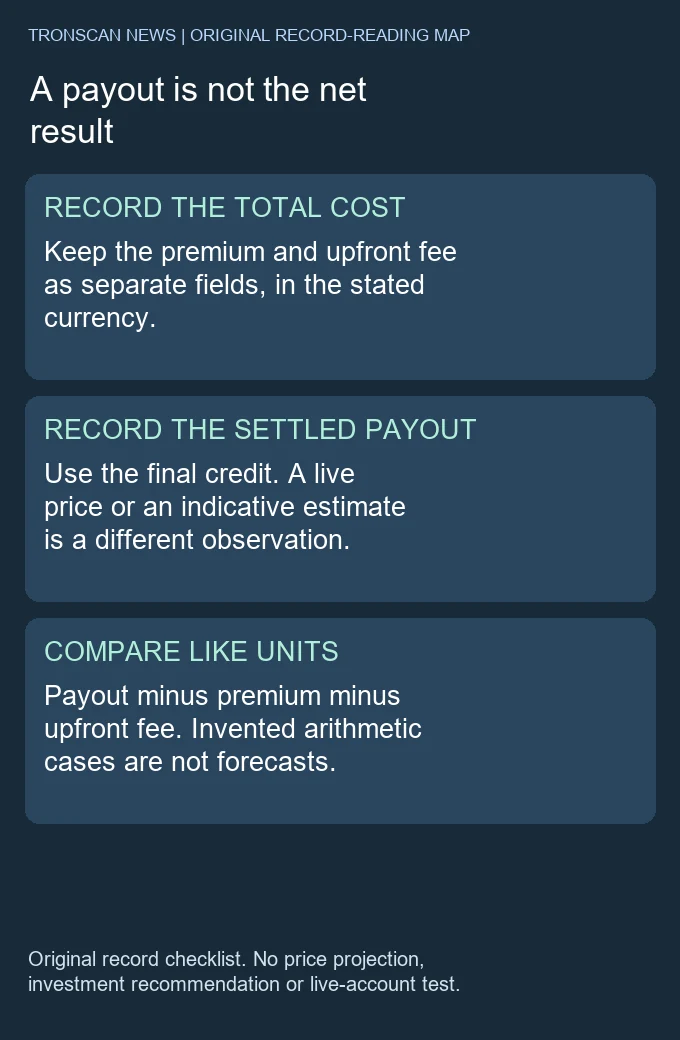
- Match costs to the same position. Preserve premium and upfront fee separately. A funding transfer total might cover several activities and cannot substitute for one position’s cost.
- Assign the next evidence source. Use a provider statement for the position and account credit. Use an explorer only for a real hash on its stated network.
Object being read:
Source / visible source date / checked date:
Underlying asset / funding currency:
Actual strike / expiry date and time:
Status: indicative / settled / credited / unknown
Premium / upfront fee / final payout (same currency):
Relevant chain and genuine hash, only if a transfer exists:
Unanswered question / evidence needed next:
An empty hash field is not automatically a failed transaction. It may mean that the object is an internal account entry. An empty currency or position identifier, however, prevents a reliable cost comparison: stop at “incomplete record” and obtain the matching statement rather than guessing from a balance change.
Four synthetic TRX options records: payout versus net result
The following invented examples test only arithmetic on same-currency records. They are not quotes, prices, predicted payouts, real trades or a pricing model. In every row, the hypothetical premium is 10 units and the upfront fee is 1 unit. The comparison is final payout minus both costs.
| Invented final payout | Arithmetic | Net result in the same units |
|---|---|---|
| 0 | 0 − 10 − 1 | −11 |
| 8 | 8 − 10 − 1 | −3 |
| 11 | 11 − 10 − 1 | 0 |
| 14 | 14 − 10 − 1 | +3 |
We verified these four results locally. They demonstrate why a positive payout can coexist with a loss, without assuming a TRX price path. They exclude tax, currency conversion and any other charge; a real statement would require its actual cost fields. A case with a different payout currency cannot be compared by subtracting the displayed numerals alone.
The provider’s risk page says the purchased option’s premium and upfront fee can be lost entirely and a payout can still fall short of cost. It also warns that indicative estimates are not guaranteed returns. These are high-risk products; this article interprets documents and records and does not recommend a position or assess suitability.
Read a completed note without inventing a transaction
Consider a hypothetical reader who has an internal account statement containing an expired TRX-linked position and a USDC credit. This is an invented record classification exercise, not an observation from Blockchain.com. The correct opening line is “provider settlement record.” Writing “TRX received” would introduce an asset-delivery conclusion that the described evidence does not support.
In the worksheet, that reader would preserve TRX as the underlying and USDC as the stated credit currency. The actual strike and expiry would be copied from the matched position. If either field were missing, the note would say “not provided.” A later withdrawal would get its own record rather than being folded into the TRX options settlement line.
There are three useful stopping points in this exercise:
- Position found, settlement missing. The record establishes a position but leaves the final outcome unknown. A live price does not fill the gap. The next evidence is the matching settlement entry, not a search for a TRON address.
- Credit found, costs missing. The account entry establishes a credit amount, but the note cannot classify the net result. Request the matching premium and fee information through the provider’s normal statement or support process; do not substitute the account’s total balance.
- Withdrawal found, network missing. The provider entry describes another operation. Its asset and destination-network details are needed before an explorer can be selected. Do not assume that a TRX-linked option requires every later movement to use TRON.
For TRX options, this separation prevents an accounting record from being presented as a public transaction receipt. It also keeps an absence of public chain evidence from being misreported as proof that an internal credit failed. We have not observed a real customer case corresponding to this exercise.
If an article or message supplies only a ticker and a claimed return, the missing evidence remains material. Ask which product, which dated terms, which position and which settled credit the claim refers to. A source link supports only the statements it actually contains; it cannot verify another person’s account outcome. None of these checks requires a wallet signature, an approval transaction, or depositing funds.
Which settlement field are you reading?
For a beginner reading the announcement, the following field distinctions prevent several common errors. This is an editorial glossary for the record worksheet, not a reproduction of an app screen. Field labels and their meanings should be checked against the current provider statement rather than assumed from the placement of a number.
| Field | How to preserve it in a note | Common misreading |
|---|---|---|
| Underlying | The asset referenced by the position, here TRX | Calling it a received coin amount |
| Actual strike | The contractual comparison level shown for the position | Replacing it with a chosen target or a later market quote |
| Expiry | The position’s specified date and time with timezone | Using the announcement date or a screenshot’s clock |
| Reference price | The designated settlement observation, with its source | Using whichever live chart is easiest to open |
| Premium and fee | Separate same-position cost entries and their units | Using the whole account’s funding transfer as the cost |
| Credit | The final recorded account entry, its asset and status | Calling an estimate a completed payout |
The provider’s definition and expiry references above supply the product meanings. Our comparison column identifies the inference to avoid. A completed row establishes only that the field was recorded correctly; it does not authenticate an account statement or establish whether another person’s screenshot is genuine.
A timezone example with a clear limit
Synthetic example: suppose a record specifies 4 November 2026 at 08:00 UTC. Applying the UTC+08:00 offset gives 4 November at 16:00 in Beijing. We verified that conversion locally using a timezone-aware date object. The date was chosen only to illustrate notation; we have not verified that an expiry on that day is offered.
Keep both forms in the note: the original UTC timestamp and the converted local timestamp. A copied “8 AM” without a zone is incomplete. If another display appears to show a different hour, first check its zone before concluding that the expiry moved. Never resolve a discrepancy by changing the source field to match the device clock.
This conversion does not calculate a payout or promise that a credit arrives at the same instant. The expiry policy separates the contract’s expiry from the availability of the reference price and subsequent processing. A local reminder can help read a record at the right time, but it is not evidence that settlement has finished. The actual provider entry remains necessary.
The provider’s regulatory-risk disclosure
The risk reference above identifies Blockchain.com (BVI) II Limited as the options provider. It states that this service is not licensed, authorized or supervised under the financial regulatory regimes described in its Options Agreement, and that users lack the protections or compensation schemes that may attach to licensed services. This is the provider’s disclosure, checked on 1 November; it is not our independent legal determination for every jurisdiction.
That disclosure matters when interpreting the launch’s reach. A familiar brand, a public press release and an account feature do not establish deposit insurance or a personal entitlement to regulated-service protections. This review does not assess suitability, recommend a purchase, or certify the legal position of a reader. Keep eligibility and protection claims tied to the exact product documentation rather than borrowing them from another product under the same brand.
Frequently asked questions
Do TRX options add TRX to my TRON address?
TRX options provide price exposure without ownership of the underlying cryptocurrency, according to the provider. Do not treat an option position as a native address balance.
Can TRONSCAN show my TRX options settlement?
Use the provider’s position and account ledger for that question. If a separate chain transfer occurs, its genuine hash can be checked through the TRONSCAN public-record guide; the ticker alone does not supply a transaction.
Does a TRX options payout mean a profit?
No. Compare a final payout with the matched premium and fee in the same currency. The invented worksheet above demonstrates a positive payout that still produces a negative result.
Can a customer close these TRX options early?
The checked policy says purchased positions cannot be sold, transferred or closed early. Provider termination under exceptional contractual conditions is a separate matter.
Did TRX options launch on 1 November?
No. We reviewed October sources on 1 November and retained their visible dates separately. Individual current access was not tested.
Prepared by the Tronscan News editorial team, an independent publication, with AI-assisted drafting and editorial source checks on 1 November 2026. Original diagrams, chronology and record worksheet were produced for this article. Public documents and local arithmetic were reviewed; no financial account, trade, payout or personal eligibility was tested. Corrections can be reported through About & Standards in the navigation.
Leave a Reply