Mercuryo’s October 22, 2026 Swaps launch materials include TRON, but their token, pair and route totals should not be treated as the same measurement. The press release states 38 digital tokens, 700 possible trading pairs and 1,400 swap routes. A separate announcement uses over 1,400 pairs and lists 21 chains. Neither total proves that a particular USDT-on-TRON route is available to a particular reader.
This is a November 2 source review of the dated October announcement, not a claim that Mercuryo launched Swaps today. The reader’s task is to preserve each count’s unit and product context, then identify the evidence still needed for a real asset-network route. We did not create an account, provide identity information, obtain an executable swap quote or carry out a financial transaction.
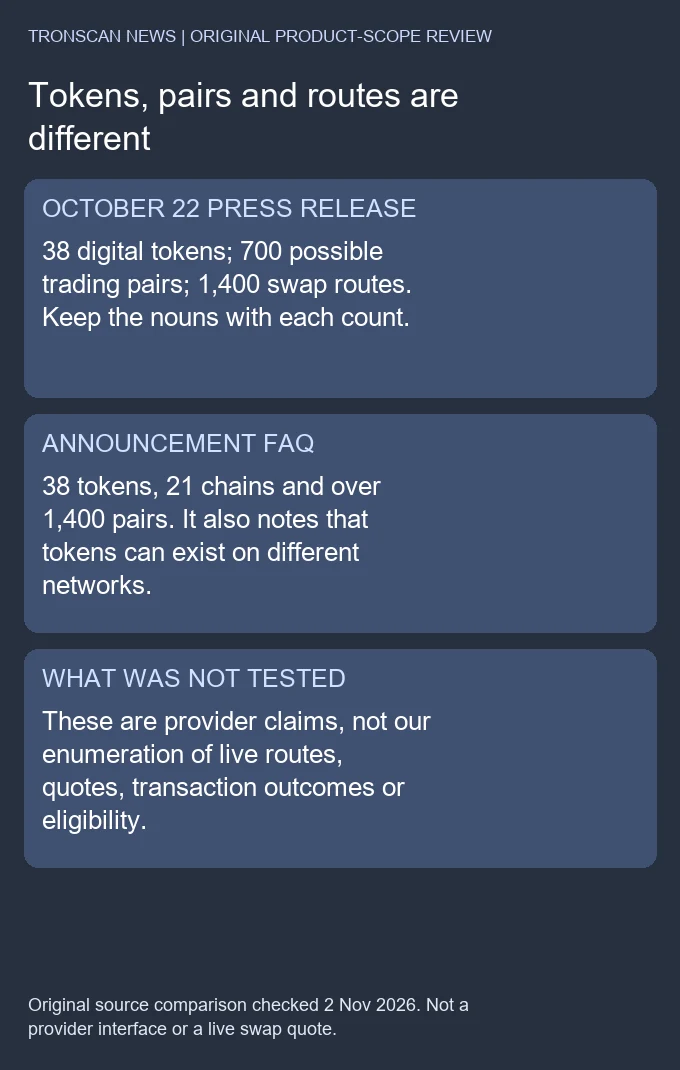
Table of Contents
What the Mercuryo launch sources actually count
The Mercuryo October 22 press release uses both pair and route language: 700 possible trading pairs appears near the beginning, while 1,400 swap routes appears after its transport-layer list. TRX is in the token examples and TRON is in the transport-layer examples. Those two roles must remain separate.
The separate Mercuryo October 22 announcement describes 38 tokens across 21 chains and over 1,400 pairs. It notes that some tokens occur on different networks. We have not established whether its counting convention, product configuration or revision timing explains the wording difference. We therefore retain the original labels rather than rewriting both pages into one verified total.
| Source checked November 2 | Count and label | What our review establishes |
|---|---|---|
| Mercuryo press release, October 22 | 38 digital tokens; 700 possible trading pairs; 1,400 swap routes | These statements coexist on that first-party page |
| Mercuryo product announcement, October 22 | 38 tokens; 21 chains; over 1,400 pairs | The wording and units differ from a single pair total |
| Mercuryo Swaps product page | 1000+ crypto pairs | A broader marketing count, not a downloadable route enumeration |
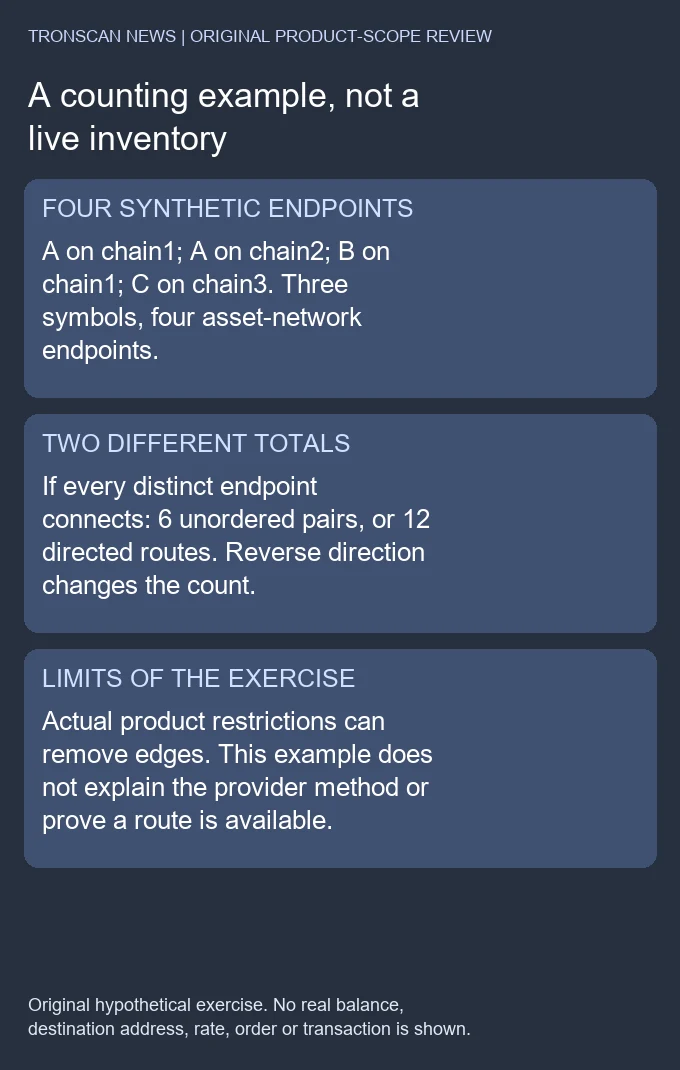
| Our local four-endpoint exercise | 6 unordered pairs; 12 directed routes | Arithmetic for a labeled hypothetical complete graph only |
The Mercuryo Swaps product page also displays promotional rate and code examples. We did not use those as a current quote, a fee schedule or evidence of a completed TRON transaction. A product illustration and a successfully executed user order answer different questions.
Three Mercuryo count distinctions to preserve
- A token symbol is not an endpoint. The same symbol on two networks can describe two different places to send or receive an asset. A record needs both the asset and the chain.
- An unordered pair ignores direction. A-to-B and B-to-A occupy one unordered pair. A product can still impose different conditions in the two directions.
- A directed route includes direction. A-to-B and B-to-A count separately in a directed model. More route names do not establish liquidity, regional access or an executable amount.
These are analytical definitions for this review. They are not a claim that Mercuryo uses our graph model internally. The two announced totals suggest a question to ask about units; they do not give us a license to invent the provider’s route-generation algorithm.
Our arithmetic check: 38 does not determine a live market
For a hypothetical set of 38 distinct endpoints with every distinct endpoint connected, excluding self-pairs, the unordered total is 38 × 37 ÷ 2 = 703. Counting both directions gives 38 × 37 = 1,406. Those numbers are close to the release’s rounded 700 and 1,400, but proximity is not proof of the counting method.
Actual route eligibility can be sparse rather than complete, an asset may have multiple network variants, and product rules may distinguish direction or amount. We do not know which restrictions were included in the published denominator. Treat the calculation as a transparent illustration, not an independent validation of all announced routes.
Our copyable Python helper computes only that hypothetical arithmetic. It does not call Mercuryo, collect a quote, enumerate supported assets or check a destination account. Its explicit integer check rejects Boolean values, rather than accepting True as a one-node inventory.
def hypothetical_pair_counts(nodes):
    if type(nodes) is not int or nodes < 0:
        raise ValueError("Use a non-negative integer")
    return {
        "nodes": nodes,
        "unordered": nodes * (nodes - 1) // 2,
        "directed": nodes * (nodes - 1),
    }
Eleven local fixtures passed: six valid counts for 0, 1, 2, 3, 4 and 38 nodes, and five rejected inputs: a negative integer, Boolean, float, numeric string and null. The exact copyable function was checked against the same six valid results. All fixtures were local and synthetic; none represents eleven service orders or a live route audit.
Why the network label matters for TRON readers
Consider four explicitly synthetic endpoints: asset A on chain 1, asset A on chain 2, asset B on chain 1 and asset C on chain 3. There are three symbols but four asset-network endpoints. A complete unordered comparison has six pairs; its directed counterpart has twelve. Dropping the chain label changes what is being counted.
That is the useful next step for a USDT reader: preserve the network with the token, even when an announcement uses a familiar ticker. The USDT network and explorer selection guide explains how the chain determines the explorer and contract context. A provider logo, a token ticker or a network name on a marketing list is not enough to reconstruct a route.
TRX and USDT are different assets. A statement that a product includes TRX does not, by itself, prove every USDT-on-TRON direction or receiving arrangement. Our table keeps that inference open rather than converting a transport-layer list into blanket support for all tokens issued there.
Regional scope and our actual entry-page observation
The Mercuryo announcement’s regional FAQ lists supported areas while excluding the USA from its North America wording. That limits how a US-focused English reader should interpret the launch. We did not test residency eligibility, identification review or a workaround, and this article does not recommend changing a country selection to obtain access.
We opened the official exchange.mercuryo.io entry linked from Mercuryo’s pages. In the observed context it displayed Buy and Sell, a US label and a default purchase form. We did not observe a Swaps control there. That is one bounded interface observation, not evidence that Swaps is unavailable everywhere or that a particular person is eligible or ineligible.
No country setting was changed, no identity information was submitted and no Buy, Sell or Swap confirmation was pressed. We retained the visible entry-page state separately from the October announcement. If a control or route is absent, the next evidence is the provider’s current product support, not an assumption that a transaction has already been created.
Three hypothetical records and their limits
The following examples are synthetic reading exercises, not Mercuryo orders or claims about supported routes. They show how a complete-looking number can still leave the practical question unanswered.
| Synthetic record | Supported conclusion | Unsupported leap |
|---|---|---|
| A quote names asset A on chain 1 as input and asset A on chain 2 as output | The two endpoints differ by network even though the symbol matches | Calling it an ordinary same-chain token transfer without examining the actual route |
| A page lists both asset B and TRON, but no combined route or amount is shown | Two separate marketing labels were observed | Declaring a live B-on-TRON swap direction, minimum amount or receiving address |
| An order status says completed, but the receiving record is unavailable | The service supplied a completion status | Inventing a transaction hash, exchange credit or independently verified balance change |
In each case, keep the observed field and the missing field in separate columns. A precise partial record is useful; filling a blank with an unrelated quote makes the result less reproducible.
A practical route-evidence worksheet
Before interpreting a service record, write down the following fields. The goal is a precise account of what was offered and observed. Blank fields remain unresolved. Do not fill them using a promotional illustration, a route in the opposite direction or a similarly named token on another chain.
Provider / product / source date / observation time:
Input asset and network / output asset and network:
Direction and exact route identifier, if supplied:
Observed regional context / product restrictions:
Requested amount and quote status, if actually tested:
Quote expiry / displayed fees / receiving amount:
Actual transaction hashes, only after an actual transfer:
What remains untested / appropriate next evidence:
This worksheet is not an instruction to execute a swap. It is a way to avoid over-reading a source or an existing order record. The TRON swap-record interpretation guide handles the different task of reading route and net-amount evidence from an actual on-chain record. Our current review did not create such a record.
If a service later reports completion, keep its order status separate from the on-chain transfer and any receiving platform’s credit. Use the USDT deposit evidence guide for that next question. A route count cannot prove settlement, confirmation requirements or exchange credit.
Frequently asked questions
Did Mercuryo launch Swaps on November 2?
The reviewed launch materials are dated October 22, 2026. November 2 is our source-check date.
Are 700 pairs and 1,400 routes necessarily contradictory?
No. Pair and route can use different units. We preserved the source wording and did not confirm the provider’s counting algorithm.
Does the 38-node calculation verify live routes?
No. It assumes a complete hypothetical graph and excludes self-pairs. Real restrictions and network variants can change the inventory.
Does TRX support prove every USDT-on-TRON route?
No. The asset, network, direction and current product restrictions still need their own evidence.
Was a Mercuryo swap completed in this test?
No. We reviewed public sources and an entry page, then ran local arithmetic fixtures. No account verification, executable quote or financial transaction was tested.
Independent Tronscan News review with AI-assisted drafting and primary-source checks on November 2, 2026. Two original diagrams, a source-unit comparison, eleven local fixtures and a bounded entry-page observation support this analysis. No provider endorsement, live route enumeration, fee promise or completed trade is claimed. Browse the Tronscan News homepage; use About & Standards for corrections.
Leave a Reply