Blockchain.com’s USDT networks depend on the product and operation you mean. A DeFi Wallet asset, a Trading Account deposit and a Pay transaction are not interchangeable support statements. The public wallet help page reviewed on 1 November 2026 includes TRON in its Trading Account USDT multichain transfer list, with regional exceptions. That is not a promise that every account can use the route.
This USDT networks review compares public documentation, not a logged-in account. We did not generate a receiving address, place an order, sign a message or send funds. The practical result is a source-mapped worksheet for identifying which question remains unanswered before you interpret an existing payment or rely on a network label.
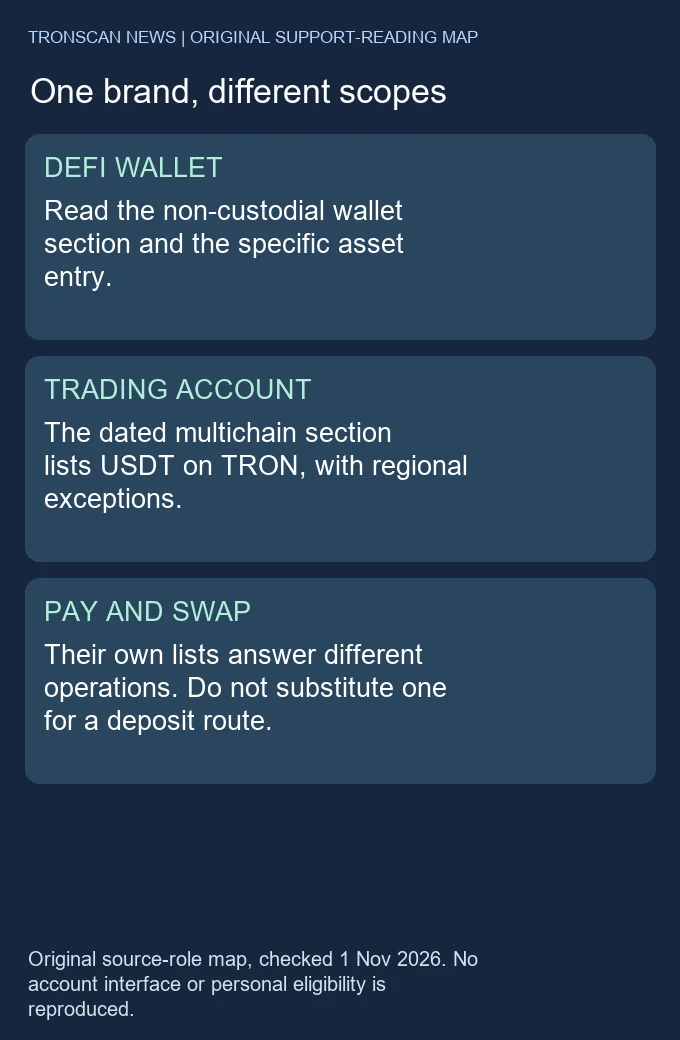
Table of Contents
USDT networks: start with the full product name
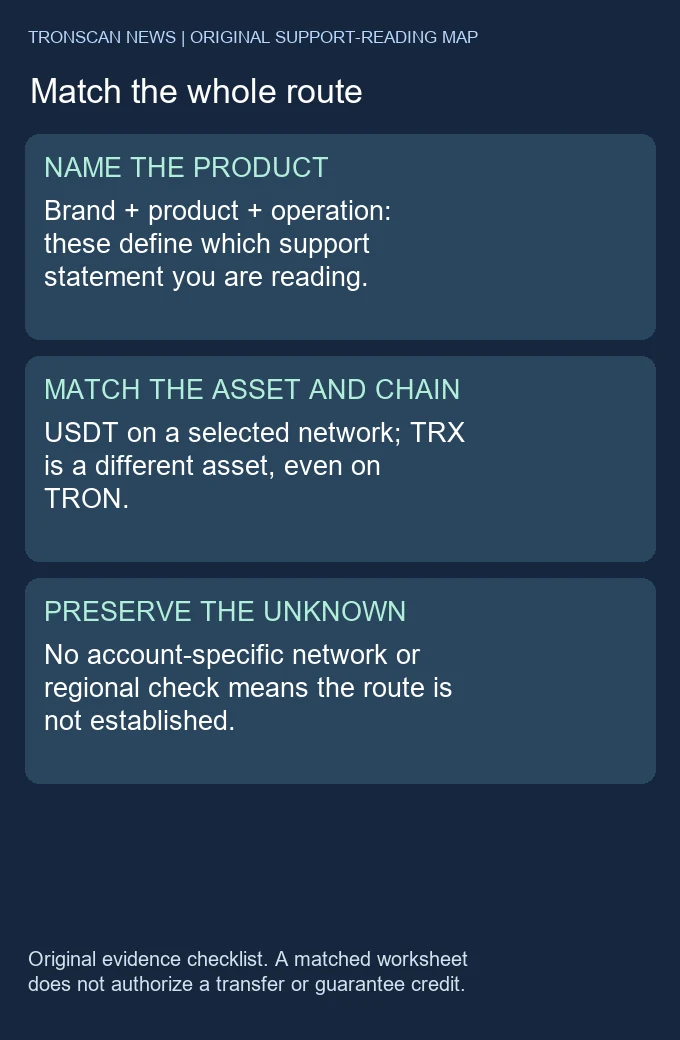
A brand name alone cannot establish USDT networks. Write down whether you are using the non-custodial DeFi Wallet, a Trading Account, Pay or a Swap function. Then name the operation: display an asset, receive a deposit, withdraw, buy or swap. These are different tasks even when they appear in the same company’s help center.
Our USDT explorer network-selection guide covers choosing the correct chain and public record. This provider-specific article addresses an earlier source-selection problem: which product’s instructions establish the route you are trying to check? It does not replace the issuer’s token identity or the actual receiving account’s current instructions.
| Source context | Question it helps answer | Do not infer |
|---|---|---|
| DeFi Wallet section | Non-custodial asset/network handling | Trading Account crediting or every token’s display |
| Trading Account multichain section | Listed deposit/withdrawal routes, subject to exceptions | Universal personal eligibility |
| Swap asset list | Assets described for that operation | A complete deposit-network table |
| Pay supported-asset page | Pay’s listed assets and network groupings | Every other product’s supported route |
| Regional exception notice | Restrictions for affected users | A worldwide restriction or permission for everyone else |
What the dated USDT networks documents actually say
The Wallet and Trading Account support reference displayed an update time of 29 October 2026, 10:58. Its non-custodial section includes TRON tokens with a display caveat. Its separate multichain transfer section names USDT on Ethereum, Ton, Tron and Solana and links regional exceptions. Read that transfer section for a transfer question rather than stopping at an earlier trading-asset list.
The Swap asset reference, updated 8 October 2026, 11:07, groups USDT under ERC-20. It is a Swap list. Reading it alongside the later transfer section reveals a scope difference; it does not establish that every product is limited to that grouping or that a deposit instruction should be overridden.
The Pay supported-cryptocurrencies reference, also showing 8 October 2026, 11:07, identifies itself as Blockchain.com Pay. It lists TRX separately and places USDT in an ERC-20 group. It also notes regional availability restrictions. We did not establish an alternative Pay USDT route from this page, and do not borrow one from the Trading Account section.
The dates above are document update labels observed during this review. They are not proof that a network launched on that date. We did not retrieve an earlier version to perform a before-and-after product test. This is an English support-reading tutorial, not a report of a new launch on 1 November.
Six common USDT networks mistakes
- Using the brand as the product. A search result for the company can lead to a page covering a different account or service. Keep the product heading with the support statement.
- Using a trading list as a deposit route. First match the requested operation. A list describing buying or swapping does not necessarily answer how a receiving address should be selected.
- Using TRX support as USDT support. TRX and USDT are different assets. A network-native coin and a token can have separate product conditions.
- Combining different document scopes silently. Preserve which source supplied the asset, network and operation. Do not create an imaginary route by taking one word from each unrelated list.
- Ignoring account and regional restrictions. A page listing USDT networks is not a completed check of the individual account’s available controls.
- Using the explorer as the account ledger. A chain receipt can identify a matching movement. It cannot establish every reason for a private platform’s deposit or display state.
These USDT networks checks are for reading evidence. They do not require a new transfer or an account change. If the current receive screen does not offer the intended route, preserve that observation and use the provider’s normal support process rather than substituting a network because a general help page mentions it.
When USDT networks sources appear to disagree
Use a three-part comparison before treating two help pages as a contradiction. First, retain both URLs and their product and section headings. A date without a section label can conceal that one source addresses trading while another addresses transfers.
Second, compare the same asset and operation. A newer page is not automatically the answer to a differently scoped question. The relevant source is the one that actually describes the product and operation being investigated, subject to its stated restrictions.
Third, if two current sources really do make incompatible statements about the same route, leave that difference unresolved and ask the provider a precise question through its official support channel. Do not resolve uncertainty by inventing a receive address, silently changing the network or assuming an exception has been removed. Our comparison identifies the question to ask; it does not submit a ticket or certify the provider’s answer.
Regional limits on USDT networks
The linked European-user USDT notice displayed 29 October 2026, 10:59. It describes restrictions for affected European users, including unavailable deposits, and identifies EU and non-EU EEA countries; it says the UK is not affected by that notice. This is a provider statement about its stated scope, not our legal interpretation.
The notice also contains historical March and April wording. We do not turn those references into a new November deadline or infer a year where a particular sentence omits one. A reader should use the current notice and authenticated account information together, especially when a service message supplies more specific conditions.
Our United States English research focus does not certify that an American reader is eligible for every product. An exclusion naming one region is not positive evidence of availability in all other regions. Likewise, a regional account restriction does not establish that the public TRON network or the token contract has changed.
USDT networks versus token-display problems
The provider has a separate TRC20 token-display help article, showing a 4 June 2026 update label. Its subject is the non-custodial wallet and address activation. It is not a general Trading Account eligibility statement or proof that a custodial deposit has been credited.
We did not perform funded activation or test a personal wallet’s display in this review. Do not send funds to an unsolicited helper to make a token appear. For an existing transfer, preserve the complete hash, network and recipient first. A current public record and an app’s presentation are separate observations.
Our USDT missing-payment troubleshooting guide distinguishes an unbroadcast withdrawal, failed execution, a matching on-chain movement and receiving-service credit. Use that task-specific sequence when the question has moved beyond documentation into a particular payment.
A copyable USDT networks evidence note
For USDT networks, keep the following labels in a trusted local note. Copy complete values from the actual sources; mark unavailable fields “not observed.” This is a plain worksheet, not a live eligibility checker, an explorer search box or a message we will send on your behalf.
Company and exact product:
Operation being investigated:
Asset and network named in the relevant section:
Official source URL and section heading:
Document update label:
Your review time and timezone:
Regional exception checked, or not observed:
Current account instruction checked, or not observed:
Full receive address, only if actually supplied:
Existing transaction hash, if one exists:
Observed chain result and token movement:
Observed provider status:
Specific unresolved question:
Next source or responsible service:
Keep the document’s date separate from your observation time. A source updated in October can be read in November without becoming November news. A screenshot containing only a token ticker is also incomplete: it leaves the product, operation and selected network unresolved.
Do not fill the receiving-address line with a contract address from an issuer list. A token’s contract identifies the asset; an actual receiving instruction identifies a destination for a particular route. An internal order reference is likewise different from a blockchain transaction hash. Preserve each under its own label.
If your evidence comes from two sessions or devices, record that context before comparing them. A changed account view and a changed public help article are different observations. Retain both dates and the exact field that differed rather than announcing a product-wide change from one screenshot.
Test USDT networks notes with five synthetic cases
We tested an original label-comparison worksheet locally on 1 November 2026. It compared product, operation, asset and network, then required an explicit account-instruction observation. These invented fixtures made no network request and did not use a real account, address, payment or regional eligibility decision.
| Synthetic case | Deliberate difference | Local result |
|---|---|---|
| A | Expected Trading Account; observation says Pay | Product mismatch |
| B | Expected deposit; observation says swap | Operation mismatch |
| C | Selected network field is blank | Network evidence incomplete |
| D | Labels match, account instructions not checked | Account evidence incomplete |
| E | Labels match and instruction check is marked | Record labels match; availability and outcome not certified |
Case A prevents same-brand documents from being treated as the same product. Case B prevents an operation label from disappearing when a note is copied. Case C keeps a blank network from being silently replaced by TRON. These USDT networks checks compare recorded inputs; they do not demonstrate that a particular account supports a particular asset.
Cases D and E expose the worksheet’s boundary. Marking a field checked does not independently verify its truth, and a local comparison cannot inspect an authenticated account. The useful result of this USDT networks worksheet is a specific missing or mismatched label. It is not a green light to transfer funds, a promise of recovery or an assessment of any service’s financial suitability.
For another person reviewing your note, explain the unresolved question in one sentence. For example, an explicitly hypothetical question is: “The source covers a deposit, but my note only records a swap list; which current receive instruction establishes the intended route?” Do not attach invented account details or describe this teaching fixture as a support case we actually submitted.
Five frequently asked questions
1. Which USDT networks does the Trading Account transfer section list?
The reviewed section names Ethereum, Ton, Tron and Solana and links regional exceptions. This is a scoped documentation observation, not verification of your account’s available deposit or withdrawal choices.
2. Can I confirm DeFi Wallet USDT networks from the Pay list?
No. Preserve the product named by the source. Different product lists should not be combined into an unsupported route simply because the company name matches.
3. Does a TRX entry establish USDT networks for that product?
No. One identifies the native asset; the other names a token and network combination. Keep the asset and chain as separate fields in the evidence note.
4. Does a document date prove when USDT networks became available?
No. It dates the displayed document update. Establishing a launch or a change requires dated evidence about that event, and a tested before-and-after claim requires both observations.
5. Did this review test a logged-in deposit or send funds?
No. We reviewed public sources and ran local synthetic comparisons. Current personal eligibility, receiving addresses and crediting outcomes were not tested.
Method and next reading
This USDT networks review contributes a cross-document scope map, dated source worksheet and reproducible local comparison, not a claim to operate the provider’s services. We did not establish live balances, prices, order execution, account access or a new network release. The diagrams were made specifically for this article and contain no product screenshot or fabricated transaction.
The provider’s separate October TRX options announcement and settlement-record review concerns a financial position rather than a USDT transfer route. Do not borrow its funding or eligibility rules for a deposit. The Tronscan News homepage links our independent tutorials. This article used AI assistance with source review under our editorial standards; retain the source, field and date when reporting a correction.
Leave a Reply