A failed USDT transaction fee can be real even when the intended token transfer did not complete. On TRON, an included smart-contract call can consume Energy and Bandwidth before it fails. To check the charge, read the execution result and the actual fee fields for the same transaction. Do not use the proposed USDT amount or the Energy fee limit as the amount paid.
This guide audits one historical TRON mainnet record, dated November 6, 2024, and rechecked on November 10, 2026. It helps you answer a narrow question: how much TRX did this failed attempt charge, and which fields support that conclusion? It does not diagnose a private wallet or quote the cost of your next transfer.
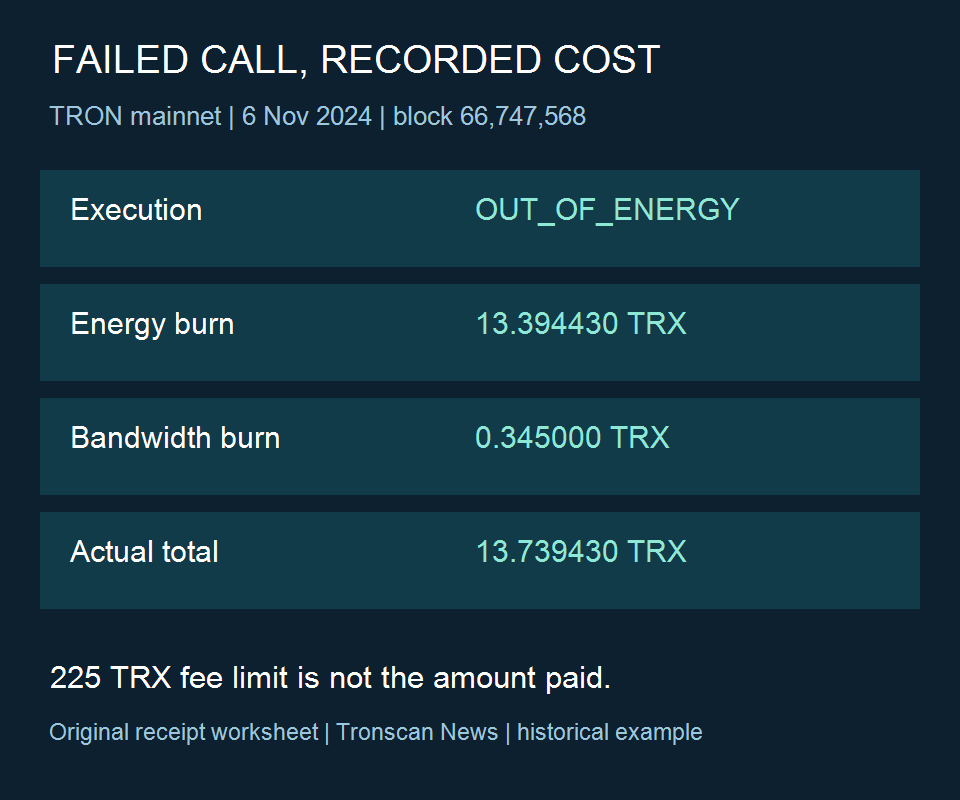
Table of Contents
Locate the failed USDT execution first
A wallet message and an on-chain receipt describe different stages. If an app did not sign, a submission was rejected, or a connection timed out, you cannot apply the fee calculation below without finding the original record. A missing search result is also not proof that the final charge was zero.
For the broader diagnosis, use our TRON transaction error guide. This page starts after you have located an included contract call and want to account for its cost. A completed fee audit identifies the network, TxID, block, execution result, fee units and arithmetic. An unexplained balance change alone is not enough.
Read confirmation and execution separately. A confirmed record can contain a failed execution. Confirmation tells you that the record is established on the chain; it does not turn its failed contract action into a successful USDT payment. Keep both labels in your notes rather than copying only the green or red badge.
A real failed USDT call with a recorded TRX charge
Open the original mainnet transaction on TRONSCAN. The full TxID is aebfcad791c00033b72c2287535512cfa929ef483eec25a91d3fb9113b62a3dd. Its block is 66,747,568, with timestamp 2024-11-06 11:23:03 UTC.
On November 10, 2026, the public page showed a failed call to transfer(address _to,uint256 _value), an Out of Energy result, a 225 TRX Energy fee limit, and a charge of 13.73943 TRX alongside 32,007 Energy. We also queried the solidified native receipt through TronGrid and compared its fields with that page. We did not create or sign this transaction.
The called contract is TR7NHqjeKQxGTCi8q8ZY4pL8otSzgjLj6t, the TRON mainnet USDT contract. Our TRON USDT guide explains checking the full contract instead of trusting a ticker. This record is not evidence about any other token with the same displayed name.
The page describes an attempted 35 USDT transfer and explicitly marks it failed. That displayed amount must not be entered as 35 USDT successfully received. The native receipt reports result: FAILED and receipt.result: OUT_OF_ENERGY, with no successful Transfer event log in the returned receipt. We make no claim about the identities of the addresses or which wallet software submitted the call.
The failed USDT transaction fee worksheet
The table below is our reconciliation of the saved native receipt. Monetary receipt values use sun: divide by 1,000,000 to express TRX. Energy counts remain Energy counts. Put the unit next to every number before doing arithmetic.
| Receipt field | Observed value | What to record |
|---|---|---|
| fee | 13,739,430 sun | 13.739430 TRX total recorded fee |
| receipt.energy_fee | 13,394,430 sun | 13.394430 TRX burned for Energy |
| receipt.net_fee | 345,000 sun | 0.345000 TRX burned for Bandwidth |
| receipt.energy_usage | 32,007 Energy | Resource usage, not a further TRX charge |
| receipt.energy_usage_total | 95,790 Energy | Total execution Energy count |
| receipt.energy_penalty_total | 25,905 Energy | Reported penalty component; do not add it again to the total |
Reconciliation: 13,394,430 + 345,000 = 13,739,430 sun. Dividing each monetary amount by 1,000,000 gives 13.394430 + 0.345000 = 13.739430 TRX. The sum matches the native receipt’s top-level fee. That is the actual failed USDT transaction fee supported by this particular record.
There is no remainder in this calculation. This does not establish that every TRON transaction has only these two monetary components. For another record, inspect all reported fee components and investigate an unexplained difference. Do not force an unfamiliar fee into the Energy category just to make a spreadsheet balance.
The numerical exercise uses historical receipt amounts directly. It does not multiply the old Energy count by a current price. Resource prices can change. Applying today’s price to a November 2024 execution would answer a hypothetical pricing question, not reconstruct its recorded charge.
Audit a failed USDT receipt on your phone
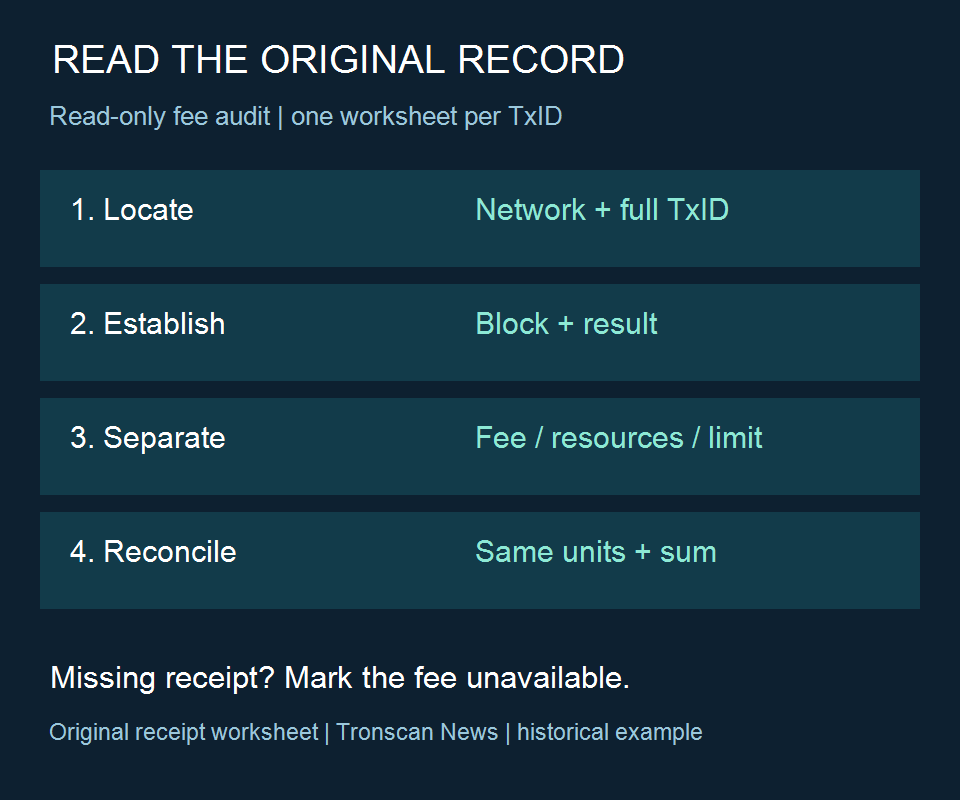
- Copy the original full TxID. Return to the sending app’s activity entry. Keep any service order number separate. If several attempts exist, make one worksheet row per TxID.
- Choose the correct network. Open the known TRONSCAN mainnet domain for a mainnet TRON record. A hash searched on the wrong network cannot establish the original outcome.
- Read the result before the amount. Save the block, UTC time, confirmation status and exact execution result. In this example, confirmation coexists with OUT_OF_ENERGY.
- Expand the resource details. Record the actual TRX charge and the separate Energy or Bandwidth values. Preserve the Energy fee limit in a different column.
- Reconcile the monetary fields. When using the native receipt, convert sun to TRX once, compare the component sum with fee, and mark missing values unavailable. Keep an unexplained difference open.
- Write a bounded conclusion. State what this record proves about the attempt. Do not infer a refund, successful recipient credit, address ownership or a guaranteed successful retry.
On the example page, the resource-detail control appears next to the charge. The layout may change, so use the field labels rather than the position of a button. Public lookup does not need a wallet connection. A request for recovery words or a signature to reveal a public receipt is outside this read-only process.
If a mobile display rounds the charge, retain the full value from the receipt when precision matters. A page showing 13.73943 TRX and a worksheet showing 13.739430 TRX agree: the trailing zero changes formatting, not value. A screenshot that hides the unit or result is insufficient for someone else to repeat the audit.
Why failure and a fee can coexist
TronLink’s official failed-transaction fee explanation, updated October 13, 2026, distinguishes execution resources from the outcome of the intended action. A contract can consume resources while running and still fail. That supports checking a fee on a failed execution rather than assuming failure makes execution free.
In the real record, the fee is not merely predicted: the native solidified receipt reports it. This is why the arithmetic begins with recorded fields. A wallet estimate is useful before authorization, but it cannot replace the receipt when you are investigating an older attempt.
The official smart-contract error reference says that Energy already used on an OUT_OF_ENERGY execution is not refunded. The practical consequence is narrow: preserve the charge while investigating the failed action. Do not present the fee as a second successful token transfer or promise that increasing a budget will solve every contract condition.
An OUT_OF_ENERGY result also does not prove that the sender was blacklisted. It identifies the reported execution failure. Account permissions, token restrictions and resource budgets are different questions. This example supplies no evidence of a blacklist cause, and we do not attach one to it.
Four numbers in a failed USDT record
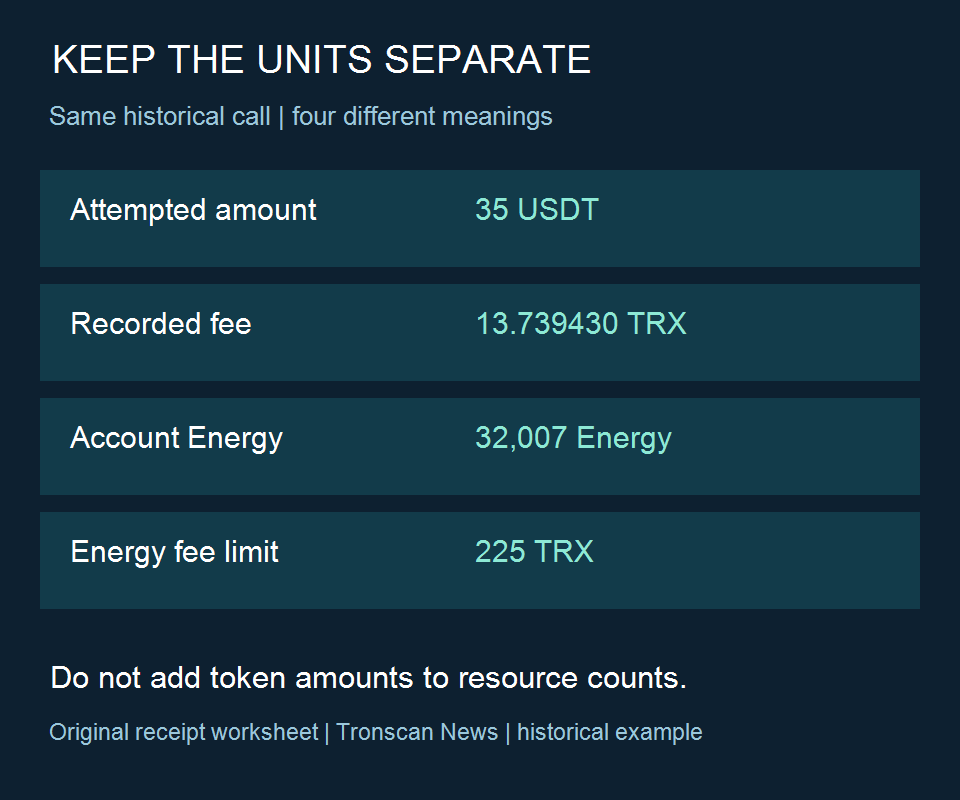
Intended token quantity: the decoded call concerns 35 USDT. It describes what the call tried to do. Because execution failed, it is not a receipt for a completed 35 USDT payment.
Actual TRX fee: the native receipt supplies 13.739430 TRX after unit conversion. It is the amount used in this record’s monetary reconciliation. Do not subtract a TRX amount directly from a USDT amount; the units describe different assets.
Energy consumption: 32,007 Energy appears alongside the TRX charge, while the native receipt also reports 95,790 total Energy. Neither number is an extra amount of TRX to add to 13.739430. A resource count and a currency charge are not interchangeable.
Energy fee limit: 225 TRX is a separate budget field displayed for this call. It is not what the sender necessarily paid. Our TRON fee limit guide explains that distinction before any change to a future transaction budget.
The original error message names an SSTORE operation and reports the remaining execution constraints. We preserve the exact OUT_OF_ENERGY outcome instead of diagnosing the wallet from that message. No private balance history was obtained, and the record alone does not establish the sender’s intention beyond the public call parameters.
A failed USDT audit note for support
Use the following fields as an evidence sheet. Replace the example values only with values you can actually read. If a provider does not expose a native receipt, retain its explorer display and state that limitation rather than filling the missing columns with zero.
- Record: network, full TxID, block and UTC timestamp.
- Outcome: confirmation status and exact execution result, recorded separately.
- Operation: contract address, method and intended token quantity, clearly labeled as attempted if execution failed.
- Charge: actual total fee, original unit, converted TRX value and component arithmetic.
- Resources: Energy counts, Bandwidth fields and fee limit, each in its own column.
- Evidence: public record link, time checked, original response if available, and any unresolved discrepancy.
- Question: ask support to explain the specific remaining issue, such as a missing receipt or a difference between its displayed debit and the recorded network charge.
For this example, the conclusion is: “The mainnet record in block 66,747,568 failed with OUT_OF_ENERGY. Its recorded fee is 13.739430 TRX, matching 13.394430 TRX for Energy plus 0.345000 TRX for Bandwidth. The page’s attempted 35 USDT amount is not evidence of successful receipt.”
That conclusion is sufficient for the public-record audit. It does not assert that a wallet returned funds, that an exchange owes a particular refund, or that no other transaction affected the account. Those questions need the relevant provider’s records and policies.
When failed USDT fee fields disagree
If the displayed charge differs from the receipt, compare the full hash first. Two attempts made close together may have similar token amounts and different fees. Make sure your screenshot, native response and support reference describe the same transaction before comparing decimals.
Next check the unit and the data source. A field called fee inside an explorer-specific object may not have the same meaning as the native receipt’s top-level fee. During this audit, the explorer API’s cost object contained a zero-valued fee field while separately reporting the nonzero Energy and Bandwidth fees. We did not treat that isolated zero as the total. The native total and visible page agreed on 13.73943 TRX.
If no receipt is returned, write “receipt unavailable,” not “free transaction.” The official receipt API reference separates transaction-body lookup from execution-receipt lookup. A transaction body can describe the proposed operation without supplying its execution costs. Historical coverage and the selected network need checking when results are incomplete.
Keep a balance investigation separate as well. Today’s TRX balance includes the effects of other transactions. Without a complete account history and reliable opening balance, it cannot identify the charge of one failed call. Do not adjust the fee worksheet until it fits a balance screenshot.
Before authorizing another attempt, resolve the actual cause with the wallet or application. A new send can create a new TxID and another charge. This article’s historical case is a reading exercise, not a recommendation to keep retrying or buy a fixed amount of TRX.
For related public-record guides, visit Tronscan News. We are an independent publication, not TRONSCAN, TRON, Tether or TronLink. We cannot alter a confirmed record, release an account restriction or reverse its recorded network charge.
Separate network costs from other debits
A failed USDT transfer can be surrounded by other paid actions. For example, an account may have a separate Energy-rental payment, an exchange service charge or another contract interaction. These are possible categories to investigate, not events we observed for the historical sender. Attach each actual debit to its own record before deciding which amount belongs to the failed attempt.
If you paid for a service outside the failed call, keep the service receipt beside the on-chain receipt. Do not add that purchase to the native fee field and describe the combined number as a network charge. Equally, the absence of a service purchase in one transaction does not prove there were no other costs. Your conclusion should identify the records you actually inspected.
A useful spreadsheet has an “evidence type” column. Put native receipt, explorer display, wallet estimate or provider invoice in that column. Then put the timestamp, amount and unit next to it. This prevents a pre-send quote from being silently substituted for a settled charge. It also lets support see whether a difference concerns blockchain execution or its own service accounting.
How to review a second failed USDT attempt
Copy the worksheet, not the old numbers. A second attempt has its own hash and receipt. Record its contract, outcome, time and fees independently, even if the recipient and intended quantity match the first attempt. Only after both rows are complete should you calculate a combined cost.
For two independently verified fees, addition can answer “what did these two attempts cost in TRX?” It cannot tell you why their Energy counts differ or what a third attempt will cost. Those questions require each call’s circumstances and a current estimate. The historical example here supplies neither a universal resource requirement nor a safe retry budget.
Stop the audit at the boundary of the available evidence. If only one receipt is accessible, report one verified charge and one unavailable result. If the wallet provides only a rounded total, preserve that precision limit. A useful support note is allowed to contain an unresolved question; replacing missing fields with plausible numbers would make it less reliable.
Frequently asked questions
Can a failed USDT transaction fee be nonzero?
Yes. An included contract execution can consume resources before it fails. In the historical mainnet record examined here, the receipt reports FAILED and OUT_OF_ENERGY together with a 13.739430 TRX total fee.
Was the 225 TRX fee limit charged in this example?
No. The visible limit was 225 TRX, while the native receipt and explorer displayed an actual charge of 13.73943 TRX. Keep the limit and actual fee in separate worksheet columns.
Did the recipient receive the displayed 35 USDT?
The failed call is not evidence of a completed 35 USDT transfer. The page marks the attempt failed, and the native receipt reports failed execution. We did not inspect private recipient or exchange records.
Should I multiply historical Energy by today’s price?
Not to reconstruct the recorded fee. Use the old receipt’s monetary fields and units. A calculation using a different date’s price is hypothetical and must be labeled separately.
Does a wallet timeout prove that I paid a failed USDT transaction fee?
No. Locate the original record and receipt first. An uncertain app response, a rejected submission and an included failed execution are different states. Keep the fee unknown until evidence establishes it.
Editorial note: AI assisted with drafting and the original explanatory diagram. The numerical worksheet was checked against the public TRONSCAN page and a native solidified receipt on November 10, 2026. The example occurred on November 6, 2024; no payment, wallet signing or recovery action was performed. Corrections should identify the affected claim and provide the supporting public record.
Leave a Reply