TRON CLOSE_EXCHANGE reached a code milestone on October 26, 2026: java-tron pull request #7059 was merged into release_v4.8.3. That is a source-code event. Our October 28 review does not establish a Mainnet activation, and the latest-release API response we collected still identified GreatVoyage-v4.8.2.4.
This dated analysis explains what the merge record supports and how to keep design, code, release and network-state claims separate. It includes a four-source evidence ledger and a tested local metadata extractor. It is not a notice that ordinary USDT transfers have been disabled or that readers must sign an upgrade transaction.
Reviewed October 28, 2026 by the independent Tronscan News editorial team. The event date is October 26. AI assisted drafting and original diagrams; we checked the linked primary records and four public JSON responses. No java-tron code was compiled, node upgraded, governance vote cast or funded transaction performed. Editorial and correction policies are available through About & Standards.
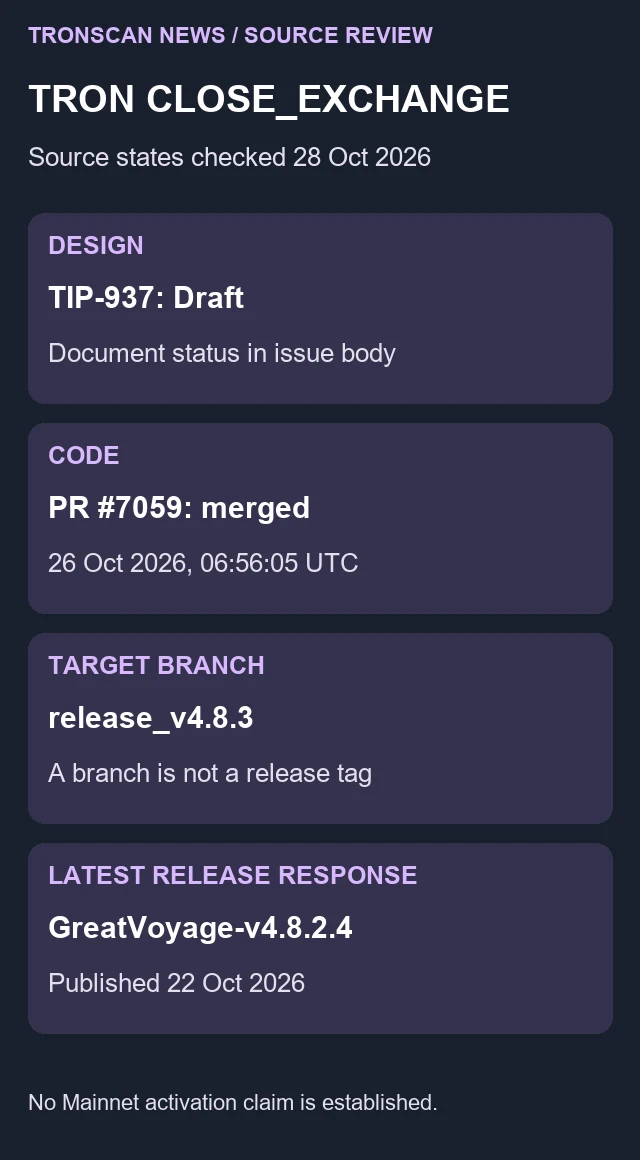
Table of Contents
1. What changed in the TRON CLOSE_EXCHANGE code record?
The official java-tron pull request #7059 records the removal of the CLOSE_EXCHANGE proposal-combination guard and related apply-side special cases. Its discussion explains the intent to make parameter application independent of ordering while retaining creation-side validation.
The public metadata returned a merge time of 2026-10-26T06:56:05Z, target branch release_v4.8.3 and merge commit 42742d793e94e7ef7227d9e85768e7d27dc1a5a8. These identifiers make the event reproducible without relying on a shortened social-media summary.
We did not run the project’s test suite. Any test counts in the pull-request description are the contributor’s reported checks, not tests performed by this publication. Our own checks are the public metadata collection and local extraction exercises described below.
A source review should retain the target branch, not only the word merged. A branch name containing a version number is still a branch name. It cannot by itself establish that a release package was published, downloaded by operators or activated on a particular network.
2. Read the TRON CLOSE_EXCHANGE design scope carefully
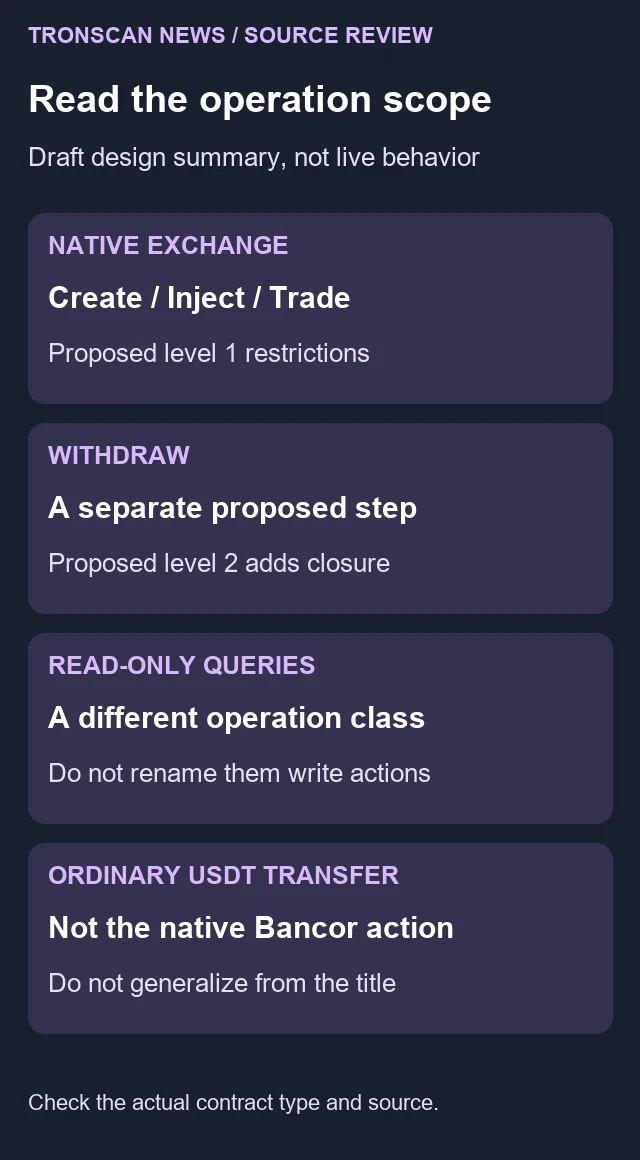
The TIP-937 design discussion describes stepwise restrictions on TRON’s built-in Bancor exchange operations. Its document body still labelled the proposal Draft when checked. The issue’s open/closed state and the document’s status are separate fields.
| Design concept | Scope described by the TIP | Reading limit |
|---|---|---|
| Initial level | No additional closure from this parameter | Existing rules still matter |
| Proposed level 1 | Restricts ExchangeCreate, ExchangeInject and ExchangeTransaction | Design wording is not proof of active Mainnet behavior |
| Proposed level 2 | Adds restriction of ExchangeWithdraw | A separate step in the proposed progression |
| Read-only exchange queries | The design distinguishes these from write operations | A query’s availability is a different question from permission to transact |
The operation names matter. This design concerns a native exchange feature; it is not a general definition of every service whose name contains exchange. Do not translate the title into a claim that all exchange deposits, all decentralized trading or all TRC20 transfers have stopped.
For an explorer reader, the useful first step is to identify the actual contract type in the record. A label on a website is weaker evidence than a specific operation name and its source context. This is our scope analysis of the named operations, not an independently tested guarantee about every application’s future behavior.
Readers who need the basic record-selection path can use our TRONSCAN guide. Keep that lookup task separate from evaluating a development proposal.
3. Audit four TRON CLOSE_EXCHANGE source states
We collected four public JSON responses at approximately 05:12:52 UTC on October 28, 2026. All four requests returned HTTP 200 and parseable JSON. The collection used no account credentials and made no changes to GitHub, a wallet or the network.
| Source | Observed result | What remains unproved |
|---|---|---|
| GitHub pull-request API for java-tron #7059 | merged true; target branch release_v4.8.3 | A deployed network version |
| GitHub issue API for tips #937 | Issue open; document body contains status Draft | A completed network governance action |
| java-tron latest-release API | GreatVoyage-v4.8.2.4; published October 22, 2026 | Every operator’s installed version |
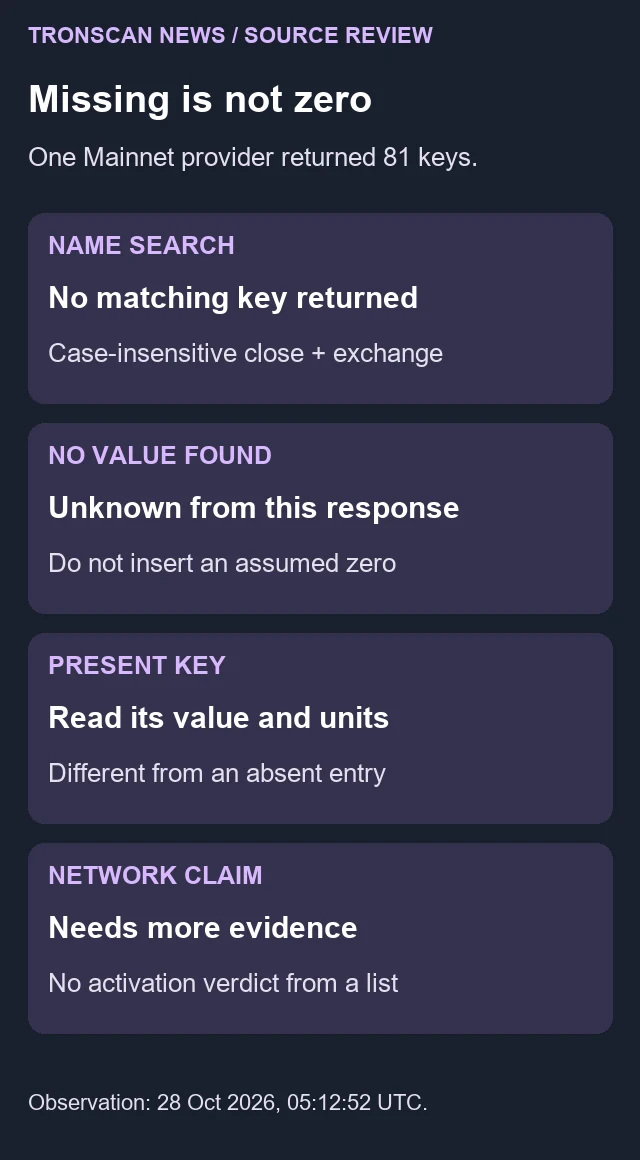
| Mainnet getchainparameters response | 81 returned parameter keys; no key matched our close-plus-exchange name search | A zero value, an activation verdict or a complete capability inventory |
The published v4.8.2.4 release page is a different record from the release_v4.8.3 branch. Our existing java-tron release coverage retains its original URL and includes that published release context. We are not presenting the October 22 package as newly released today.
The latest-release response is a dated observation of one repository endpoint. It does not establish that no other tag, prerelease or development build exists. Nor does it tell us what a particular public node is running. Keep the exact endpoint and its scope in the evidence ledger.
Our parameter-name search was deliberately narrow: a case-insensitive match requiring both close and exchange in a key. No matching key appeared in this response. That result is useful for documenting the limit of our inspection, but it must not be converted into an assumed value of zero.
The official parameter documentation distinguishes API key names from numeric proposal identifiers and describes querying current values. A missing API entry and a present entry whose value is omitted under a default convention are different situations. The former does not supply a value.
Our dated Mainnet parameter audit provides a separate unit-selection method. This news review uses the parameter list only to bound what we observed; it does not repurpose an absent key into a governance result.
4. Reproduce the TRON CLOSE_EXCHANGE metadata review
- Open the primary pull request and record its number, merge time, target branch and merge commit. Do not stop at a screenshot of the title.
- Open the linked TIP and record both the issue state and the document status in its body. Preserve the observation date because the wording can change.
- Inspect the repository’s latest-release response and retain its tag, publish time, draft flag and prerelease flag. Keep this collection distinct from branch inspection.
- For a network-specific question, collect the relevant read-only response and its exact endpoint. Record missing fields as unavailable.
- Run the local extractor below against saved JSON files, then compare its output with the claim ledger.
- Write only the conclusion that the collected source states support. Leave release deployment and network activation unresolved unless separately verified.
The four public collection URLs were https://api.github.com/repos/tronprotocol/java-tron/pulls/7059, https://api.github.com/repos/tronprotocol/tips/issues/937, https://api.github.com/repos/tronprotocol/java-tron/releases/latest and https://api.trongrid.io/wallet/getchainparameters.
Save the responses in the same order as pull-source.json, tip-source.json, latest-release-source.json and parameters-source.json. Keep endpoint and retrieval-time notes outside those raw files. The extractor reads local copies; it does not contact GitHub or TRON.
import json
import re
from pathlib import Path

def review_sources(pull, tip, release, parameters):
    for item in (pull, tip, release, parameters):
        if not isinstance(item, dict):
            raise ValueError("Expected four JSON objects")
    if type(pull.get("merged")) is not bool:
        raise ValueError("Missing boolean merge status")
    base = pull.get("base")
    if not isinstance(base, dict) or not isinstance(base.get("ref"), str):
        raise ValueError("Missing target branch")
    if type(release.get("draft")) is not bool or type(release.get("prerelease")) is not bool:
        raise ValueError("Missing release flags")
    if not isinstance(release.get("tag_name"), str):
        raise ValueError("Missing release tag")
    body = tip.get("body")
    if not isinstance(body, str):
        raise ValueError("Missing TIP document body")
    match = re.search(r"(?m)^status:\s*([^\r\n]+)", body)
    rows = parameters.get("chainParameter")
    if not isinstance(rows, list):
        raise ValueError("Missing parameter array")
    keys = []
    for row in rows:
        if not isinstance(row, dict) or not isinstance(row.get("key"), str):
            raise ValueError("Invalid parameter entry")
        if row["key"] in keys:
            raise ValueError("Duplicate parameter key")
        keys.append(row["key"])
    return {
        "merged": pull["merged"],
        "merge_utc": pull.get("merged_at"),
        "target_branch": base["ref"],
        "tip_document_status": match.group(1).strip() if match else "unknown",
        "release_tag": release["tag_name"],
        "release_draft": release["draft"],
        "release_prerelease": release["prerelease"],
        "matching_parameter_keys": [key for key in keys
            if "close" in key.lower() and "exchange" in key.lower()],
        "network_activation": "not evaluated by this extractor"
    }

if __name__ == "__main__":
    names = ("pull-source.json", "tip-source.json",
             "latest-release-source.json", "parameters-source.json")
    inputs = [json.loads(Path(name).read_text(encoding="utf-8")) for name in names]
    print(json.dumps(review_sources(*inputs), indent=2))
Run python review_sources.py after saving the example under that name beside the four source files. The result preserves the branch and release tag as different strings. Its network_activation field explicitly says that activation is not evaluated by the extractor.
5. Check what the TRON CLOSE_EXCHANGE extractor can prove
We ran the extractor against the four actual saved responses. It returned merged true, the October 26 merge time, target_branch release_v4.8.3, tip_document_status Draft and release_tag GreatVoyage-v4.8.2.4. The release flags were both false. The matching_parameter_keys array was empty.
We also ran seven synthetic local checks aimed at preventing misleading source-state conclusions. All behaved as intended. These were tests of our metadata-handling method, not java-tron consensus tests or a Mainnet activation experiment.
| Synthetic change | Expected local result | Reason |
|---|---|---|
| Remove the document status line | tip_document_status remains unknown | Missing status is not acceptance |
| Add a getCloseExchange key with value zero | Key appears in the match list; activation stays unevaluated | Key discovery and activation analysis are separate |
| Replace the release tag with a synthetic v4.8.3 label | Branch remains separate; no activation verdict appears | Matching version text is not a deployment test |
| Replace boolean merged with the text true | ValueError | A string is not the expected API flag |
| Remove the target branch | ValueError | The merge destination is required context |
| Remove the parameter array | ValueError | An unavailable response is not an empty match list |
| Duplicate a parameter key | ValueError | The extractor does not silently choose an occurrence |
The synthetic key and tag above were deliberately altered local fixtures. Neither was returned by our real collection. Keeping them labelled prevents a demonstration of the program from becoming a false claim about current TRON CLOSE_EXCHANGE data.
The extractor’s name search is not a complete parameter registry. A renamed key could escape it, and a provider’s response can have its own coverage limits. The correct conclusion is that our chosen search returned no match in that response, not that every possible endpoint must return the same list.
6. Keep a TRON CLOSE_EXCHANGE claim ledger
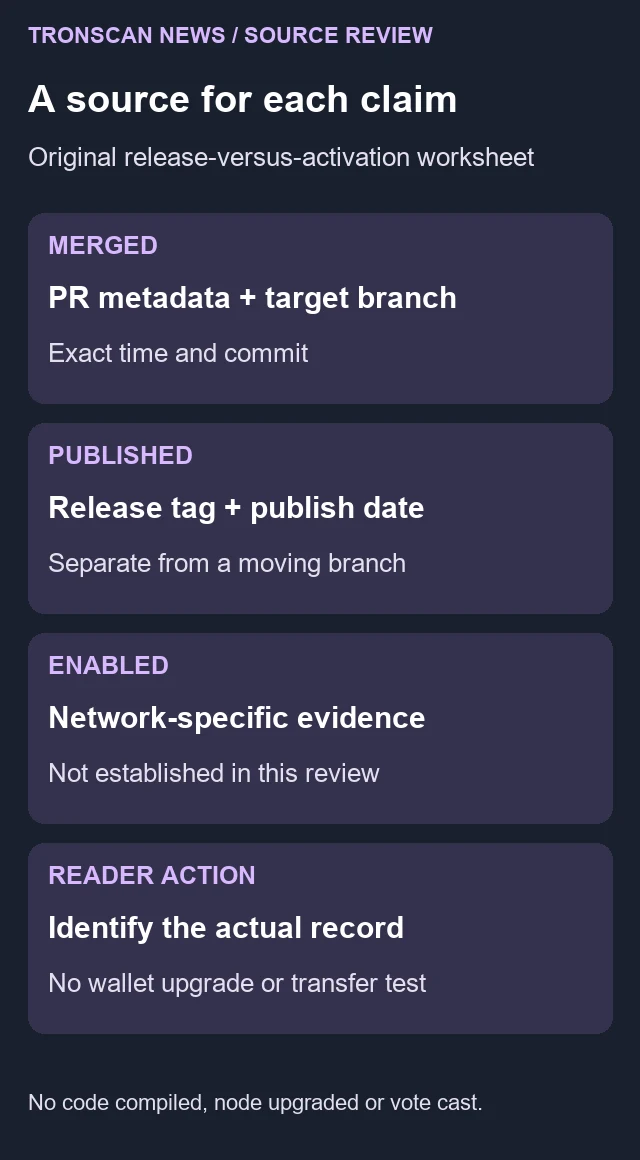
Use this original worksheet when evaluating a later update. It identifies the evidence needed for each statement instead of treating every development milestone as the same event. The blank or unresolved stages are part of the result.
| Proposed statement | Required source context | Result in this review |
|---|---|---|
| A design was described | TIP text, document status, retrieval date | Observed, with Draft status retained |
| A change was merged | Pull request, destination branch, merge time, commit | Observed for PR #7059 |
| A version was published | Release tag and publication metadata | Latest-release endpoint returned v4.8.2.4 |
| A particular node runs that version | Node-specific operational evidence | Not inspected |
| A rule is active on Mainnet | Network-specific activation and state evidence | Not established |
| A particular transaction was rejected by that rule | Exact record, operation and response message | No such transaction test performed |
Synthetic reading exercise: imagine a headline says that a feature is live because a development branch contains the relevant change. Locate the row that the supplied evidence actually supports. If the only record is the merged pull request, the supported statement concerns code integration. The node-version, activation and transaction-outcome rows remain open.
Now imagine that a later release tag includes the same change. Add that release record to the ledger, with its date and version. Do not overwrite the earlier merge time or retroactively describe the feature as active on the day of the merge. The ledger should show what evidence became available at each stage.
Finally, imagine a service displays an error after that release. Match the actual operation and exact error before attributing the failure to this design. A nearby release date and an unavailable transaction do not establish causation. Keep alternative explanations unresolved until the relevant records can distinguish them.
These exercises are not predictions about how TRON CLOSE_EXCHANGE will be deployed. They explain how to make a future report reviewable. The same source discipline helps readers avoid confusing a code repository’s progress with a wallet instruction or a network-wide incident.
7. What should a reader check next?
For someone reading ordinary transfer records, begin with the record’s network, asset and contract type. This review supplies no reason to connect a wallet or move funds. If a page uses the development headline to request a signature, the headline alone does not establish that the request is necessary or authorized.
For a developer tracking the design, preserve the exact commit and branch state you reviewed. A branch can advance after collection, so a later screenshot of its current head may not describe the code state in an earlier note. Keep the commit identifier alongside the moving branch name.
For a source analyst, recheck the unverified stage before writing an activation claim. A release record, a node response and a governance record answer different questions. If a relevant response is unavailable, report that limit rather than replacing it with an inferred default.
Keep a correction log beside the source ledger. Record the old statement, the new evidence, its retrieval time and the specific conclusion that changed. If only the TIP wording changes, update that source row without silently changing the recorded merge time. If a later release appears, add its tag and publication date without describing the earlier branch snapshot as that package.
Also separate collection failures from project states. A rate-limit response, an unavailable page or JSON with an unexpected shape is an unsuccessful observation. It is not evidence that a pull request was unmerged or a proposal withdrawn. Preserve the failure and leave the affected field unknown until a suitable source becomes available.
This recordkeeping method makes CLOSE_EXCHANGE follow-ups easier to review: the reader can identify which evidence changed, which earlier observation remains valid and which deployment question is still unanswered. It does not require rewriting the history to make every source appear to agree at one moment.
The next update to this article should be triggered by a new primary fact that changes one of the ledger’s unresolved rows. A repeated social post, a formatting edit or the passage of another day is not by itself a new release or activation event. The October 26 event date should remain visible in any later revision.
Other English record-reading paths are available from the Tronscan News homepage. Follow the remaining evidence task rather than treating every development update as a request to transact.
Frequently asked questions
Was TRON CLOSE_EXCHANGE activated on Mainnet on October 26?
This review does not establish that. It verifies a code merge into release_v4.8.3 on that date. Network activation requires separate evidence that was not obtained here.
Does a merged branch mean a software release was published?
No. A target branch and a published release tag are different records. Our dated latest-release response identified GreatVoyage-v4.8.2.4, while the merged change targeted release_v4.8.3.
Does the TRON CLOSE_EXCHANGE title mean all USDT transfers are disabled?
No such conclusion follows from this review. The design names native Bancor exchange operations. Identify the actual contract type and current network evidence before generalizing to another operation.
Does an absent matching parameter key mean its value is zero?
No. Our name search found no matching key in one response. That supplies no value. A present entry with a default-valued field and an absent entry are different cases.
Did Tronscan News run the project’s consensus tests?
No. We collected public source metadata and tested our local extractor with seven synthetic checks. We did not compile java-tron, upgrade a node or test activation. Contributor-reported project tests are not our test results.
Leave a Reply